Pottery Barn
Pottery Barn Comfort Sofa Reviews + Honest Verdict
By Erin Mitchell · Updated September 2026
Independent editorial review. We never accept payment for coverage, though we may earn a commission if you purchase through our links.
Verdict
PB Comfort owners split between praising the frame's long-term durability and flagging the stock cushions as the weak point. The blogger Nina Hendrick reported solid bones after seven-plus years of ownership, "the investment has been a good one", while one Reddit owner found the cushions underwhelming enough to swap them for aftermarket high-density foam inserts. The slipcover and bench cushion options are the practical choices for longevity.
Read full take ↓Similar sofas
Quick Take
A deliberate neutral, priced as a premium mid-market sofa on the same sinuous-spring system most sofas use at this tier. The engineered-wood frame with mortise-and-tenon joinery is solid without being the eight-way hand-tied construction of higher tiers. Families should choose it for the slipcover program rather than for the springs.
A sofa built to disappear into the room
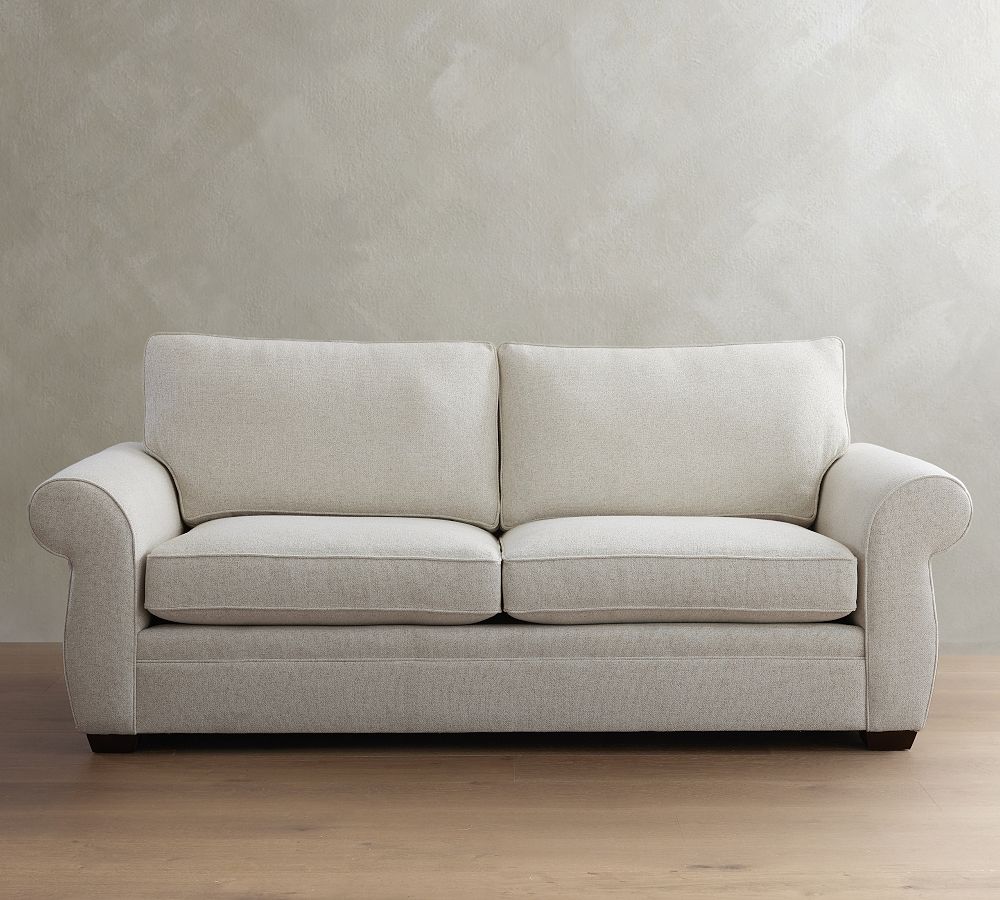
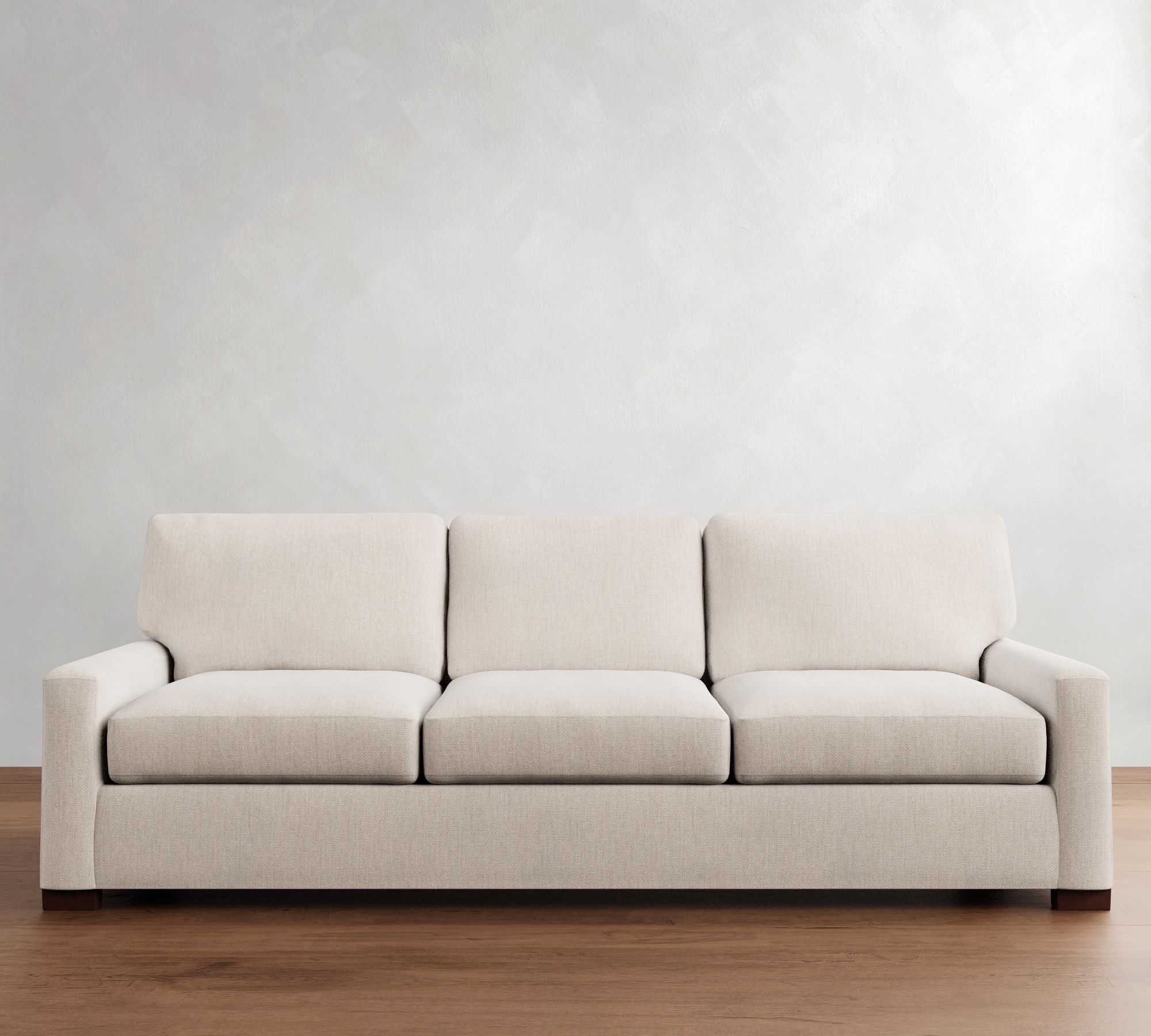
Some people shop for a sofa the way a good art director picks a neutral, on purpose, so it won't demand attention. The Pottery Barn Comfort Square Arm Sofa is for that shopper. It isn't a statement piece. It's a beautifully constructed, deeply practical sofa that stays in the background of a well-designed room and lets everything else talk. That's a design choice, not a shortcoming. The square arm profile is classic American upholstered furniture, not cutting edge, not trying to be. It reads like furniture that has always been in the room, which is what a lot of people want. The sofa your guests remember as "the comfortable one" rather than "the one that looks like something."
Solid construction and a slipcover program
The construction story is quieter than the pitch on higher-end sofas, and worth understanding. The Comfort runs on no-sag steel sinuous springs in an engineered wood frame with mortise-and-tenon joinery, the same suspension most sofas use at this tier. At $2,299-$4,200+ depending on configuration and fabric, you are not paying for premium eight-way hand-tied springs here, so the value has to come from elsewhere. It does: the frame is solid and corner-blocked, the sofa is upholstered at PB's Sutter Street factory, and the slipcover program keeps it in service for years. Those are the legitimate arguments for choosing PB over a visual lookalike, not the spring type.
The down-blend back cushions need fluffing
Know this trade-off before you buy, because it becomes a weekly reality. The back cushions use a down-blend fill. They feel exceptional on delivery, that signature Pottery Barn plushness that makes you sink back and feel like the price was worth every dollar. They also need maintenance to stay that way. Down-blend cushions compress with use and want regular fluffing and rotation. Plenty of long-term Pottery Barn owners describe a weekly fluffing routine as part of owning the sofa. Some people find that completely normal. Others find it genuinely annoying. Be honest about which one you are before you order. The bench cushion upgrade, available at additional cost, solves the problem structurally. Swapping the multiple loose back cushions for a single bench-style cushion on the seat, or moving up to more structured back options, ends the loose-pillow maintenance cycle. If you're buying the Comfort, take that upgrade seriously before you finalize the order. Owners who skipped it early and added it later say they wish they'd decided upfront.
The slipcover advantage
Pottery Barn's slipcover program for the Comfort is unusual in the furniture market. When the fabric wears out, typically after eight to twelve years of regular use, you order a new slipcover in a completely different fabric and refresh the sofa instead of replacing it. On a piece with good bones underneath, that stretches the useful life considerably. It also lets the room's palette evolve around the sofa. Buy a neutral performance fabric now, want a warmer linen in five years, and the option is there. No other sofa at this price point offers that kind of long-term flexibility.
Who this sofa is for
The Comfort's buyer wants quality construction in a neutral, unfussy design, a piece that reads right in a traditional, transitional, or relaxed contemporary space without demanding a design commitment. Often it's going in a family room, or any room where the sofa gets used hard and has to hold up. These buyers care less about design trends and more about whether the sofa is still comfortable in eight years. Pottery Barn runs 20-30% sales constantly, and they're worth waiting for. At 20% off the listed price, the Comfort moves from reasonable to genuinely good value for the build quality and the slipcover program.
Competitive context
The closest comparable is the Pottery Barn Cameron Roll Arm: same construction quality, slightly warmer look from the rolled arms. The Comfort is the more neutral, adaptable option; the Cameron has more design personality. If you want PB quality without a design statement, the Comfort fits more rooms. If you want warmth and character, take the Cameron.
What the Comfort does that others don't
Very few mass-market sofas pair a solid engineered frame and sinuous-spring build with a slipcover program and a price that responds to seasonal promotions. That combination is the Comfort's position. You aren't buying a design statement, you're buying a sofa engineered to stay comfortable, durable, and adaptable for as long as you own the frame underneath. The absence of aesthetic ambition is deliberate. It anchors a room without defining it, holds up without demanding care beyond the cushion fluffing, and takes on a new fabric identity when the first one has run its course. For buyers who think about furniture as infrastructure rather than self-expression, that set of properties is exactly right.
The long-term value math
Run the full lifecycle: a Comfort Square Arm bought at a 25% discount, owned for 10 years, slipcover replaced once at the midpoint, then passed on or donated with a functional frame. Spread across quality, utility, and flexibility, that annualized cost compares favorably against nearly any sofa in the tier. The solid frame and the slipcover program are why the math works. You refresh the fabric instead of replacing the sofa, and the frame outlasts the first cover.
Frame and construction
The Comfort Square Arm sits on an engineered wood frame with mortise-and-tenon joinery and corner-blocked joints for rigidity, with removable solid rubberwood legs. It's the frame standard Pottery Barn uses across their upholstered line, and it has proven reliable over the 10+ year lifespans multiple owners report.
No-sag sinuous spring system
The seat runs on no-sag steel sinuous springs, heavy-gauge S-shaped wires clipped front to back across the seat frame. They give firm, even support and a responsive give under weight, and adjustable levelers keep the sofa stable on uneven floors. It is the same suspension most sofas use at this price, so the Comfort's case rests on the frame, the upholstery, and the slipcover program rather than a premium spring.
Seat and back cushions
Seat cushions come two ways: a down-blend wrap over foam for a softer feel, or poly-wrapped memory foam for a firmer, more structured one. Either holds shape better than pure down and skips the daily maintenance all-down fills demand. The seat depth is generous and the medium-soft feel is well calibrated for a comfort-forward sofa. Back cushions carry a higher proportion of down blend, and that's where the maintenance requirement lives. The pillows feel luxurious on delivery and will stay that way with regular redistribution, but they go noticeably flat without it. The bench cushion upgrade, which replaces or supplements the loose back configuration, is the clean solution for owners who want the comfort without the upkeep.
Fabrics and the slipcover program
Pottery Barn's fabric library runs over 100 options, including performance weaves, cotton-linen blends, velvet, and the company's proprietary performance fabrics. For households with children or pets, the performance fabrics, particularly the performance tweed and everyday performance linen, carry higher rub counts and resist spills. Standard linen and cotton options want more care. The slipcover-compatible design is a structural feature, not an afterthought: the upholstery is cut to take replacement covers, and PB keeps slipcover inventory for current and recent models. It's one of the most underappreciated parts of the Comfort's long-term value proposition.
Delivery and warranty
Pottery Barn's white-glove delivery service is consistent and well-rated. The Comfort ships fully assembled or with minimal installation. Pottery Barn does not publish a manufacturer warranty on the sofa; the product page states none, and coverage is limited to a 30-day return window. In practice the frame construction outlasts the fabric by a wide margin.
Our Ratings
Overall score
No-sag steel sinuous springs in an engineered-wood frame with mortise-and-tenon joinery, a solid build though not the eight-way hand-tied construction of higher tiers. Two cushion options: a softer down-blend or poly-wrapped memory foam that holds shape better over time, with the bench configuration the most shape-stable. Upholstered at Pottery Barn's Sutter Street Factory.
The Comfort Square Arm is a deliberate neutral. Clean square arms, classic proportions, nothing in it that will clash with anything else you own. It's built on longevity over statement, which is the right call for the buyer it's after. The fabric program is extensive.
At $2,299-$4,200+ the Comfort is priced as a premium mid-market sofa on sinuous-spring construction, the same system most sofas use at this tier. The premium buys brand recognition, the slipcover program (real value for families), and domestic upholstery at the Sutter Street Factory. If spring quality is your priority at this budget, also look at eight-way hand-tied options.
What People Are Saying
PB Comfort owners split between praising the frame's long-term durability and flagging the stock cushions as the weak point. The blogger Nina Hendrick reported solid bones after seven-plus years of ownership, "the investment has been a good one", while one Reddit owner found the cushions underwhelming enough to swap them for aftermarket high-density foam inserts. The slipcover and bench cushion options are the practical choices for longevity.
Reddit and Houzz commentary are weighted 3× against blog and editorial sources in our sentiment score. Brand PR has a well-documented influence on editorial coverage — direct owner reports from message boards tend to be more candid.
What Reddit Is Saying
“I got the PB Comfort instead. The cushions were pretty shitty so I replaced them with high-density foam inserts from Foam Factory (cost me about $200 in total), which have held up great so far.”View thread →
What Houzz Is Saying
“I've had a PB upholstered bed for the past 6 years. It was made by Mitchell Gold. Looks the same as the day I bought it. It's micro suede.”Source →
“Denise-I did a google search yesterday when I saw your posting. There were good reviews on the PB webset and mixed reviews elsewhere--some bad. It's so hard to know. Do they have the sectional you are looking at at the store?? If so, that may give you an indication of how it might wear.”Source →
What Others Are Saying
“For having them for over seven years and the fact that they still look great, I'd say the investment has been a good one!”Source →
“It is SO comfortable. We love how deep the seats are, and it is such a great couch to cozy up on! We have had this sectional for 10 years and it still looks AMAZING.”Source →
Frequently asked questions
Is the Pottery Barn Comfort Sofa worth it?
A deliberate neutral, priced as a premium mid-market sofa on the same sinuous-spring system most sofas use at this tier. The engineered-wood frame with mortise-and-tenon joinery is solid without being the eight-way hand-tied construction of higher tiers. Families should choose it for the slipcover program rather than for the springs.
How is the Pottery Barn Comfort Sofa built?
No-sag steel sinuous springs in an engineered-wood frame with mortise-and-tenon joinery, a solid build though not the eight-way hand-tied construction of higher tiers. Two cushion options: a softer down-blend or poly-wrapped memory foam that holds shape better over time, with the bench configuration the most shape-stable. Upholstered at Pottery Barn's Sutter Street Factory.
What styles does the Pottery Barn Comfort Sofa work with?
The Comfort Square Arm is a deliberate neutral. Clean square arms, classic proportions, nothing in it that will clash with anything else you own. It's built on longevity over statement, which is the right call for the buyer it's after.
What do real owners say about the Pottery Barn Comfort Sofa?
PB Comfort owners split between praising the frame's long-term durability and flagging the stock cushions as the weak point. The blogger Nina Hendrick reported solid bones after seven-plus years of ownership, "the investment has been a good one", while one Reddit owner found the cushions underwhelming enough to swap them for aftermarket high-density foam inserts. The slipcover and bench cushion options are the practical choices for longevity.