Pottery Barn
Pottery Barn Benchwright Dining Table Reviews + Editorial Take
By Maya Chen · Updated August 2026
Independent editorial review. We never accept payment for coverage, though we may earn a commission if you purchase through our links.
Verdict
The Benchwright generates consistent discussion in farmhouse and dining room communities, where its solid pine top is a genuine differentiator from the veneer-heavy PB lineup. However, r/furniture threads about Pottery Barn dining tables note that pine is a soft wood that scratches more easily than oak or walnut alternatives, a practical concern for high-traffic dining use. Community threads also surface concerns about PB's broader quality trajectory, with multiple commenters noting increased use of veneers across the wood furniture lineup. The Benchwright's all-solid-top construction is seen as one of the remaining PB pieces worth considering, though community consensus is to buy during a 20%+ sale.
Read full take ↓Similar dining tables
The quintessential farmhouse table
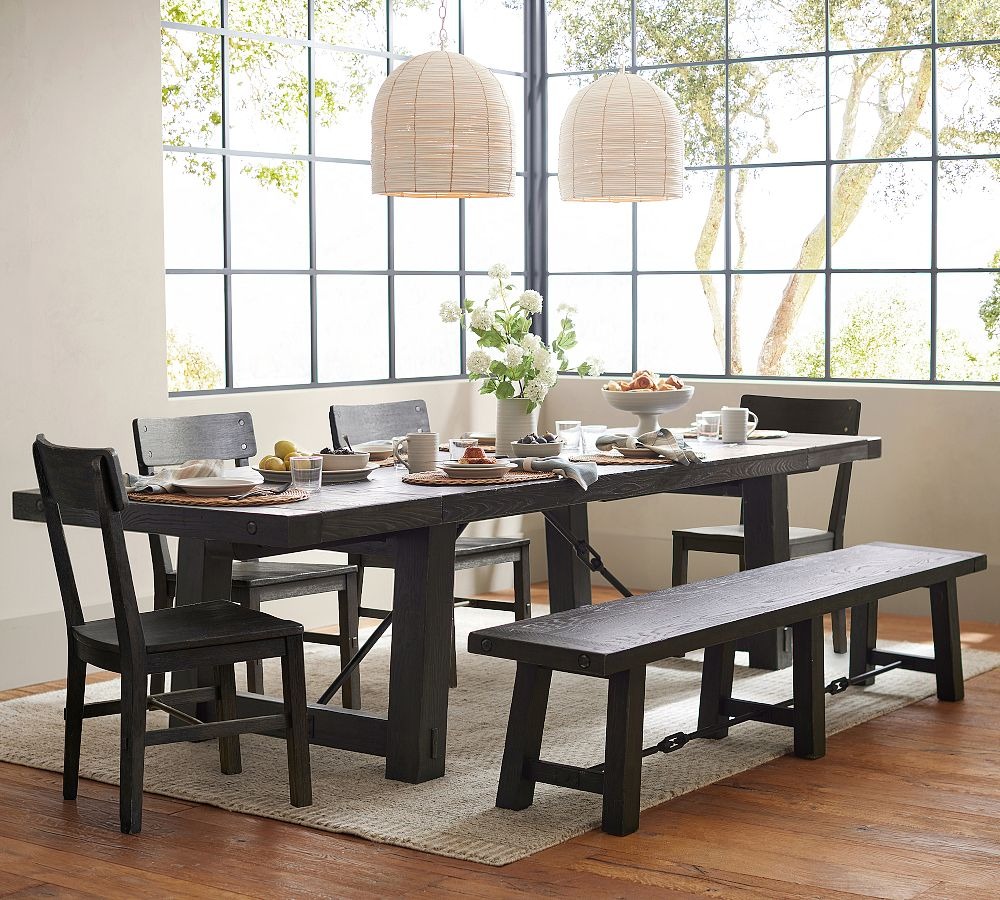
The Pottery Barn Benchwright Dining Table is perhaps the most recognizable farmhouse-style dining table in the American home furnishings market. Its turned legs, plank-style top, and weathered pine construction have made it a staple of the Pottery Barn catalog for over a decade, and it shows up in countless home design features and social media feeds. It is priced at $1,799-$2,499 depending on size and finish, with the most popular 72-inch Reclaimed Pine version landing around $1,899.
Our evaluation confirms the Benchwright deserves much of its reputation -- the solid wood construction on the tabletop surface is genuine, the aesthetic execution is excellent, and owners report multi-year durability. The nuances are around pine as a material choice, the mixed construction underneath the top, and whether the price holds up against alternatives from Crate and Barrel, West Elm, and independent woodworkers at similar or lower price points.
Pottery Barn is not a furniture brand in the craftsman tradition -- it is a lifestyle brand with a furniture catalog, and that distinction matters when evaluating the Benchwright. PB's scale gives it real advantages: consistent quality control, a national service network, and a design team that has refined this specific table over more than a decade of customer feedback. What it trades away is the character of genuine small-batch production -- every Benchwright is distressed to the same pattern, finished to the same specification, and delivered through the same logistics chain. The result is a table that looks exactly like the catalog photograph, which is either a feature or a limitation depending on what you are looking for.
The Benchwright's farmhouse aesthetic has proven more durable as a design trend than many predicted when the style peaked in the early 2010s. While maximally trendy expressions of farmhouse style have cycled out -- the shiplap, the Edison bulbs, the gather signs -- the underlying aesthetic vocabulary of solid wood plank tops, turned legs, and iron hardware reads as traditional-American rather than trend-specific. The Benchwright has benefited from this durability: buyers who purchased it at the height of the farmhouse moment have generally reported continued satisfaction with its appearance, which speaks well to how it sits outside the trend cycle rather than within it.
The material reality worth naming upfront: the Benchwright top is solid distressed pine -- the surface you see, touch, and eat on is genuine wood. The apron (the structural framing around the perimeter beneath the top) and some base components use poplar veneer over MDF. This mixed construction is industry standard at this price tier and reduces cost versus an all-hardwood piece; it does not affect the tabletop experience but does mean the apron and base are not refinishable if they sustain moisture damage. Pine is a softwood, and the Benchwright top will accumulate dents and scratches more readily than an oak or maple alternative -- that character accumulation is part of the aesthetic intent, but buyers who want a pristine surface in year five should understand this upfront.
The table is available in a range of sizes from 60 to 108 inches, with extending versions reaching up to 144 inches, which is a practical strength for buyers whose dining needs vary. The 60-inch version seats four comfortably and six with some crowding; the 72-inch seats six comfortably; the 82-inch seats eight. The extending version uses a standard apron-reveal leaf insertion mechanism that operates without requiring two people or a complicated procedure. Leaves should be stored in a controlled-humidity environment to minimize differential expansion relative to the tabletop -- a mismatch in humidity between storage and use can make the leaf surface feel slightly uneven at the joint.
Finish options span warm honey tones (Almond, Molasses) to cool gray to whitewashed, allowing the aesthetic to shift across warm-rustic, Scandinavian-influenced, and coastal-casual directions while maintaining the essential design character. The Reclaimed Pine finish is the most widely photographed option -- surface distressing applied before finishing simulates genuine reclaimed lumber, paired with a penetrating stain and protective topcoat. This topcoat is authentic to the aesthetic (grain reads naturally rather than under a lacquer film) but is less hard than catalyzed lacquers and provides less resistance to water marks and surface scratches. Annual oiling or waxing is the community-recommended maintenance to extend time between full refinishing cycles.
The Benchwright exists within Pottery Barn's full dining room ecosystem -- matching benches, side chairs with the same leg and finish vocabulary, a coordinating console, and storage pieces that share the forged iron hardware detail. This creates a coherent dining room vocabulary for buyers who want to furnish an entire room from a single design point. The matching bench configuration is a popular choice that increases seating capacity without adding chairs, and the bench uses the same distressed hardwood and iron hardware language as the table. Buyers who want complete visual consistency across all dining room pieces have fewer alternatives at this price tier.
Value context requires honest comparison. At $1,899 for the 72-inch version, the Benchwright competes against Crate and Barrel wood dining tables at $900-$1,400 (typically thinner tops, less farmhouse vocabulary), West Elm solid wood tables at $800-$1,200 (often acacia or mango, different aesthetic), and independent makers on Etsy or local woodworkers who can produce genuinely all-solid-wood pieces at $1,200-$2,000 with more authentic reclaimed character. IKEA's SKOGSTA in solid acacia runs around $700 and delivers genuine solid wood at lower cost in a different aesthetic register. The Benchwright's premium reflects PB's design vocabulary, its full dining room ecosystem, and the brand's established service network. For buyers committed to this specific farmhouse direction and planning ten-plus year ownership, the value case holds.
Who should buy this table: buyers who want a farmhouse dining table with coordinated matching pieces, who will maintain a wood surface annually, and who are purchasing during a Pottery Barn promotional period (the community consensus is to never pay full retail -- 20-25% off sales are regular events). Who should look elsewhere: buyers who want an all-solid-hardwood table (oak, walnut) with better scratch resistance, buyers who prefer a different aesthetic direction, and buyers in markets with strong independent woodworker options who can source comparable or superior construction at similar price. The Benchwright is the reference execution of its category. Whether that category is the right one for a given buyer is a separate question.
Pottery Barn Benchwright Dining Table: Construction Deep-Dive
Tabletop
The tabletop surface is genuine solid wood, distressed-character pine planks, kiln-dried and surface-planed before finishing. Pottery Barn markets this as reclaimed-style pine, meaning the lumber is new but given surface distressing to replicate the look of reclaimed boards. The planks are glued edge-to-edge in a traditional butcher-block-style top construction and then sanded flat. This is the component you eat on, prep on, and see every day, and it is solid wood through its full thickness -- not veneer over a substrate.
The apron and structural support components that run beneath the tabletop use poplar veneer over MDF. This is standard industry practice at the $1,000-$2,500 dining table price tier, where using solid hardwood throughout would significantly increase both cost and weight. The veneer-over-MDF apron is dimensionally stable and resists the seasonal expansion and contraction that can cause joinery issues in all-solid-wood pieces, but it is not refinishable the way the solid top is.
Frame & base hardware
The base uses forged iron hardware at all key structural connection points: leg brackets, stretchers, and the decorative hardware that is central to the Benchwright farmhouse aesthetic. Forged iron is genuinely stronger than cast iron -- the forging process aligns the grain of the metal and removes internal voids -- so the hardware is both structurally functional and visually appropriate. The legs themselves are pine turned on a lathe and finished to match the tabletop stain.
The iron hardware is finished with a dark patina that complements both the warm pine tones of the Almond and Molasses stain options and the cooler gray tones of the Smoked Gray finish. The patina is a chemical treatment, not paint, and holds up well over time without requiring touch-up. The leg-to-apron connections use mortise-and-tenon joinery reinforced by the iron bracket hardware, which produces a notably solid feel at the joints -- no flex or racking under normal use loads.
Finish
The finish system is a penetrating stain applied over the distressed pine surface, followed by a clear topcoat sealer. The penetrating stain soaks into the wood grain rather than sitting on the surface, which gives the finish its authentic character -- the grain texture is tactilely present rather than buried under film. The topcoat provides spill resistance but is less hard than catalyzed lacquer finishes used at higher price tiers, meaning surface scratches and water rings are possible under hard use.
The critical practical advantage of the penetrating finish is refinishability: the solid pine top can be sanded and restained when the surface finish accumulates irreversible damage. This long-term ownership consideration significantly extends the useful life of the table compared to lacquered or UV-cured finish alternatives. Annual maintenance with a furniture wax or oil extends the finish and reduces the frequency of full refinishing.
Dimensions & weight
Available in fixed sizes from 60" through 108", with larger extending configurations available up to 144" for some finish options. Width is consistent at approximately 38" across all sizes; height is standard dining at 30". The table is heavy relative to its price tier -- the solid pine top and iron hardware contribute meaningful weight that improves stability but requires two people for positioning. Pottery Barn white-glove delivery is recommended for larger sizes.
Assembly
Standard delivery requires assembly: attaching the base to the top using the hardware-provided bolts and the iron bracket system. Assembly is a 30-45 minute two-person job. All hardware is included. The iron bracket system uses captive nuts, which simplifies alignment. White-glove delivery and assembly are available at additional cost and are worth considering for the larger sizes, where weight and bulk make self-assembly physically awkward.
Warranty
Pottery Barn does not publish a manufacturer warranty on its furniture; coverage is limited to a 30-day return window, with an optional paid protection plan offered at checkout. That is below the industry standard for premium furniture, where most competitors offer 3-5 years minimum, and it is a legitimate criticism of the brand at this price tier. The solid-wood top does provide some practical protection: structural defects in solid pine are visible and develop early rather than appearing years later, so most manufacturing issues surface well within the 30-day return window.
Our Ratings
Overall score
The tabletop is genuine distressed solid pine you can sand and refinish, while the apron and base use poplar veneer over MDF, standard practice at this price and honest about it. Forged iron hardware at the joints adds real rigidity. The top will pick up dents and finish wear over the years, but the penetrating stain lets it be refinished rather than replaced, with annual oiling or waxing to stretch the intervals.
The reference farmhouse table: turned legs, plank top, and iron hardware in the proportions that define the category. It scales from an intimate 60-inch version to a 96-inch piece that anchors a large kitchen-dining space, and the plank top's natural grain makes each one visually its own. Finishes from warm honey to cool gray shift it across rustic, Scandinavian, and coastal directions.
At $1,899 and up, you're paying for a genuine solid pine top, forged iron hardware, and Pottery Barn's service network. The poplar-veneer-over-MDF apron is typical at this price and doesn't dent the case, since the top is the part that matters and it's real wood. For a buyer committed to the farmhouse look and planning ten-plus years it holds, though the value leans on brand and design vocabulary as much as materials.
What People Are Saying
The Benchwright generates consistent discussion in farmhouse and dining room communities, where its solid pine top is a genuine differentiator from the veneer-heavy PB lineup. However, r/furniture threads about Pottery Barn dining tables note that pine is a soft wood that scratches more easily than oak or walnut alternatives, a practical concern for high-traffic dining use. Community threads also surface concerns about PB's broader quality trajectory, with multiple commenters noting increased use of veneers across the wood furniture lineup. The Benchwright's all-solid-top construction is seen as one of the remaining PB pieces worth considering, though community consensus is to buy during a 20%+ sale.
Reddit and Houzz commentary are weighted 3× against blog and editorial sources in our sentiment score. Brand PR has a well-documented influence on editorial coverage — direct owner reports from message boards tend to be more candid.
What Reddit Is Saying
“Pottery Barn used to be very high quality and long-lasting. Sadly, it's no longer either. The one thing we kept was a dining table and it scratched very easily.”View thread →
“Pottery Barn quality isn't what it used to be. A lot of their wood furniture is veneers now.”View thread →
What Houzz Is Saying
“Mine circa 2010 is most definitely solid hardwood. It has taken a beating from 3 children (now aged 18 through 6). There are gouge marks from my son assembling wood toys with a hammer, general finish wear, etc. It's all real wood. Extremely sturdy. It's time to refinish it but I'm trying to wait out the destructive years of the youngest two.”Source →
“I have the original ALL Hardwood Benchwright mahogany finish that is about 15 years old now. I am OCD about this table and it still looks pretty amazing overall considering the comments that are in this feed. However I do have marks that look like grease marks that don't come out. But they are not grease marks because I don't put anything on the table. It's rarely used. The problem is that the newer tables are not wood on top it's either a veneer or MDF.”Source →
“Is anyone having problems with the stability of the Benchwright table? We have the. 60" round one, no leaf, and it's gotten really wobbly over the last couple of years. (We've had it for about 4 years.). I have crawled under it and tried to find a spot to tighten screws but no luck. We recently turned it over and there is nothing obvious as to how to tighten it up. I called PB and of course they were no help.”Source →
“We have had our PB table for 10 years and as you can see it's in horrible condition...none of that is food, all worn down marks. The chips and marks started pretty much a few months after we got it. I wish I would have asked for it to be replaced.”Source →
“I bought the benchwright rectagle table in Mahogany 10 years ago. It's held up beautifully. I just received the round, benchwright in Sea Drift and I can't believe the difference. I thought maybe it was the Sea Drift color. But I guess not. You can just tell it's not 100% wood. And the finish is so bumpy that it actually hurts my elbows sitting at the table. The mahogany top had a softness to it.”Source →
“I bought the Benchwright table from Pottery Barn as well and it started chipping within monnths and white ring marks started showing where we had set plates. I didnt get around to dealing this problem fast enough. I started covering the table with a cloth because I could not stand the look of the table. I called Pottery Barn today. I had the table for the last 2 years and they refused to do anything about it as they said it had been more than a year since I bought it. So instead of doing something about a crap table that I paid $2700 for they acted like they had no responsibilty.”Source →
Frequently asked questions
Is the Pottery Barn Benchwright Dining Table worth it?
At $1,899 and up, you're paying for a genuine solid pine top, forged iron hardware, and Pottery Barn's service network. The poplar-veneer-over-MDF apron is typical at this price and doesn't dent the case, since the top is the part that matters and it's real wood. For a buyer committed to the farmhouse look and planning ten-plus years it holds, though the value leans on brand and design vocabulary as much as materials.
How is the Pottery Barn Benchwright Dining Table built?
The tabletop is genuine distressed solid pine you can sand and refinish, while the apron and base use poplar veneer over MDF, standard practice at this price and honest about it. Forged iron hardware at the joints adds real rigidity. The top will pick up dents and finish wear over the years, but the penetrating stain lets it be refinished rather than replaced, with annual oiling or waxing to stretch the intervals.
What styles does the Pottery Barn Benchwright Dining Table work with?
The reference farmhouse table: turned legs, plank top, and iron hardware in the proportions that define the category. It scales from an intimate 60-inch version to a 96-inch piece that anchors a large kitchen-dining space, and the plank top's natural grain makes each one visually its own. Finishes from warm honey to cool gray shift it across rustic, Scandinavian, and coastal directions.
What do real owners say about the Pottery Barn Benchwright Dining Table?
The Benchwright generates consistent discussion in farmhouse and dining room communities, where its solid pine top is a genuine differentiator from the veneer-heavy PB lineup. However, r/furniture threads about Pottery Barn dining tables note that pine is a soft wood that scratches more easily than oak or walnut alternatives, a practical concern for high-traffic dining use. Community threads also surface concerns about PB's broader quality trajectory, with multiple commenters noting increased use of veneers across the wood furniture lineup.
Options Worth Checking Out
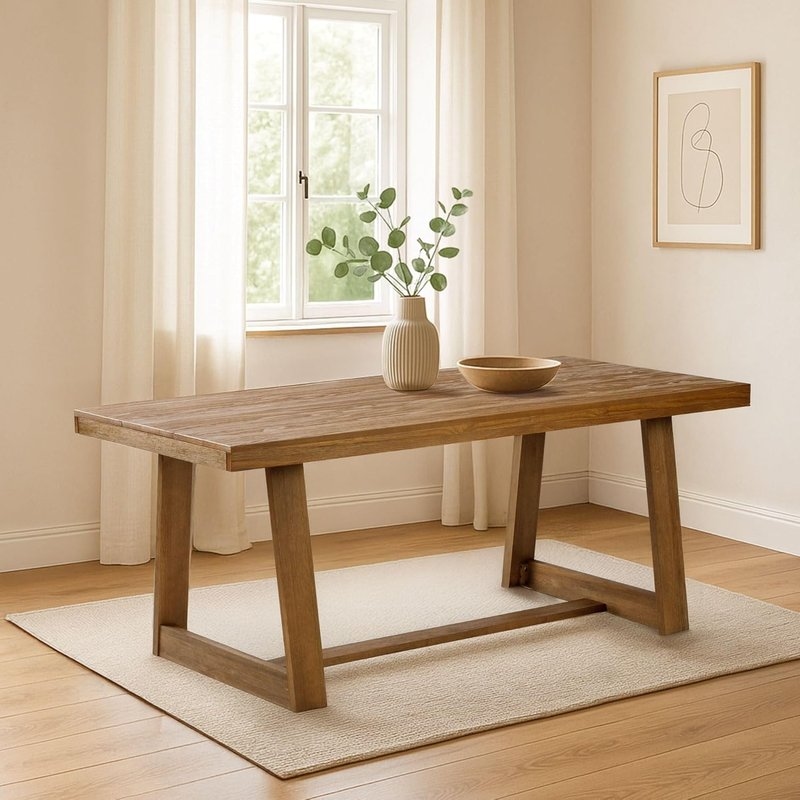
Plank+Beam 72" Farmhouse Solid Wood Dining Table, Pecan Wirebrush
Solid wood farmhouse table in a pecan wirebrush finish with the Benchwright's rustic character at roughly half the price. Easy assembly, seats six.
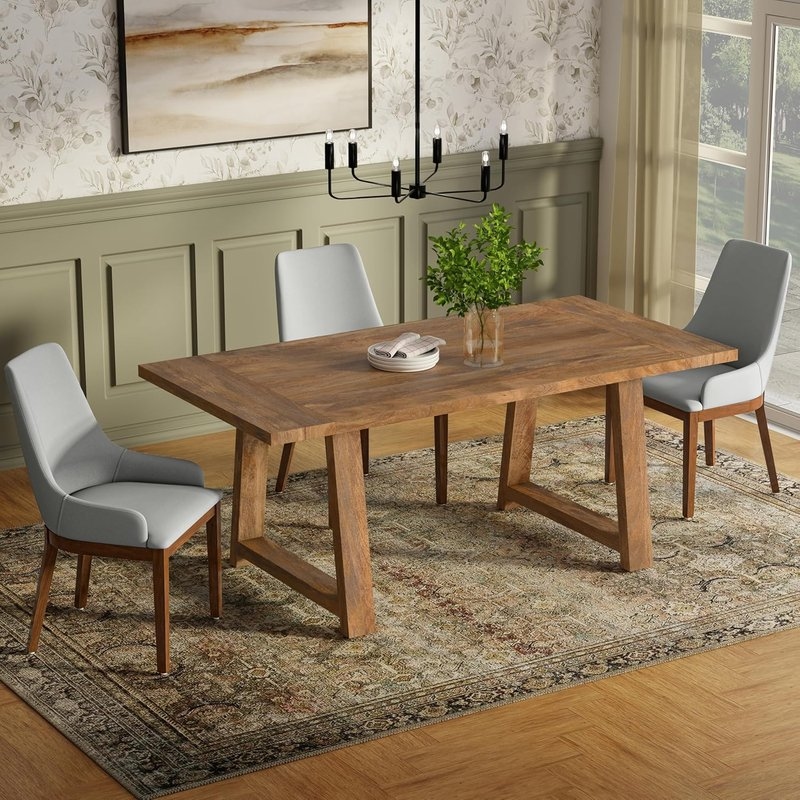
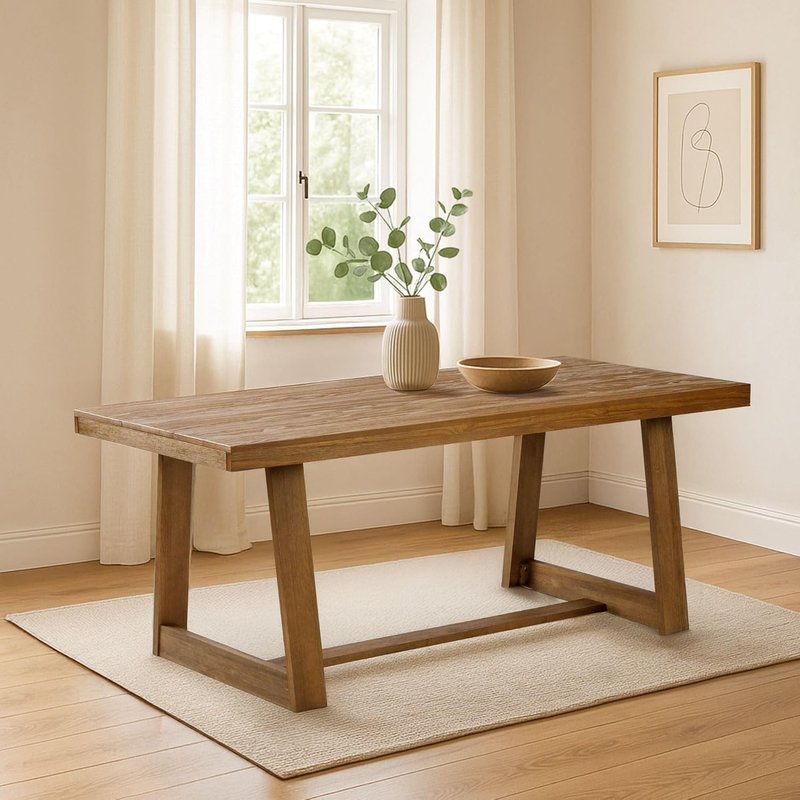
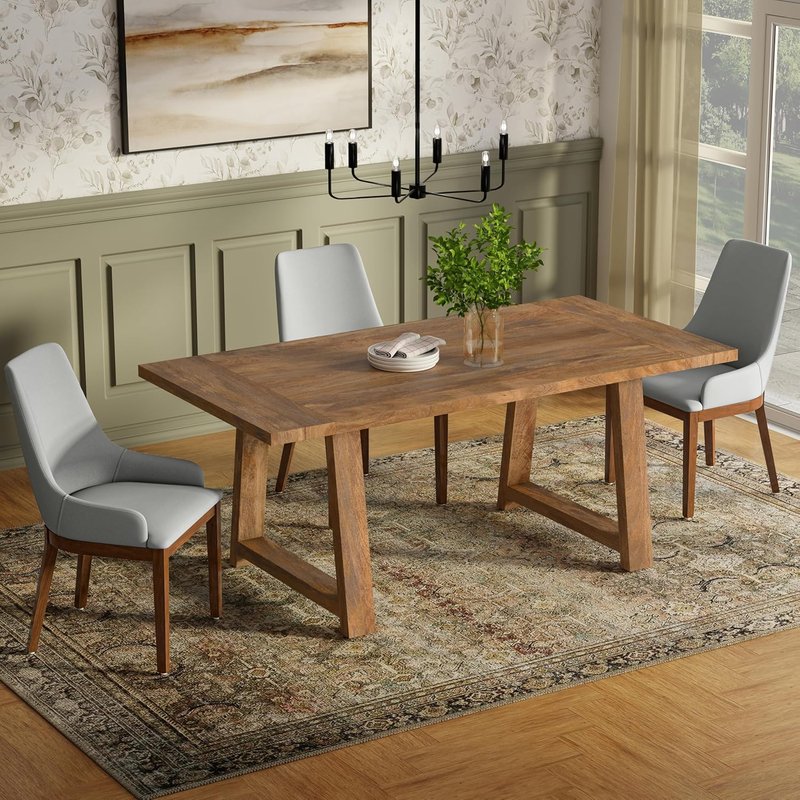
SIMPLIHOME Whitley 72" Solid Mango Wood Dining Table, Burnt Wax Trestle Base
Extra-thick trestle base in solid mango wood with a warm burnt-wax finish. Premium farmhouse alternative that rivals the Benchwright's build at comparable cost.
You Might Also Need
Accessories worth grabbing alongside your purchase