The Best Outdoor Storage Sheds for Small Yards on Amazon (2026)
By Maya Chen · Updated July 2026
Independent editorial guide. We never accept payment for coverage, though we may earn a commission if you purchase through our links.
Quick Take
For a small yard the right shed is almost always vertical rather than walk-in. A 4x3 ft footprint against a fence or house wall holds a string trimmer, leaf blower, hand tools, and a couple of bikes without eating usable lawn. Resin panels take weather without the rust that ruins steel sheds in coastal or mulched-bed conditions, and a $200 to 450 budget covers the bracket where build quality stops being a coin flip.
The caveats: vertical resin sheds don't come anchored out of the box, so plan on bagged sand or ground anchors before storm season. Floors are usually sold separately on the cheapest models, which matters more than it sounds once the contents are bags of soil or anything that can wick up from a wet slab. Skip particleboard kits entirely. They survive one wet winter and start swelling at the seams.
Below: the vertical, walk-in, and deck-box options that fit a townhouse, condo, or starter-home yard without dominating the space. See picks ↓
Shed shopping for a small yard is a different problem than shed shopping for a quarter-acre lot. You're not asking how much square footage you can buy. You're asking how much storage you can get without turning the yard into a storage yard. The picks below are sorted by footprint and price, not brand loyalty. All five are resin or HDPE construction, all five are at least nominally weather-rated, and all five fit in a space a townhouse owner can spare.
Why vertical beats walk-in when the yard is small
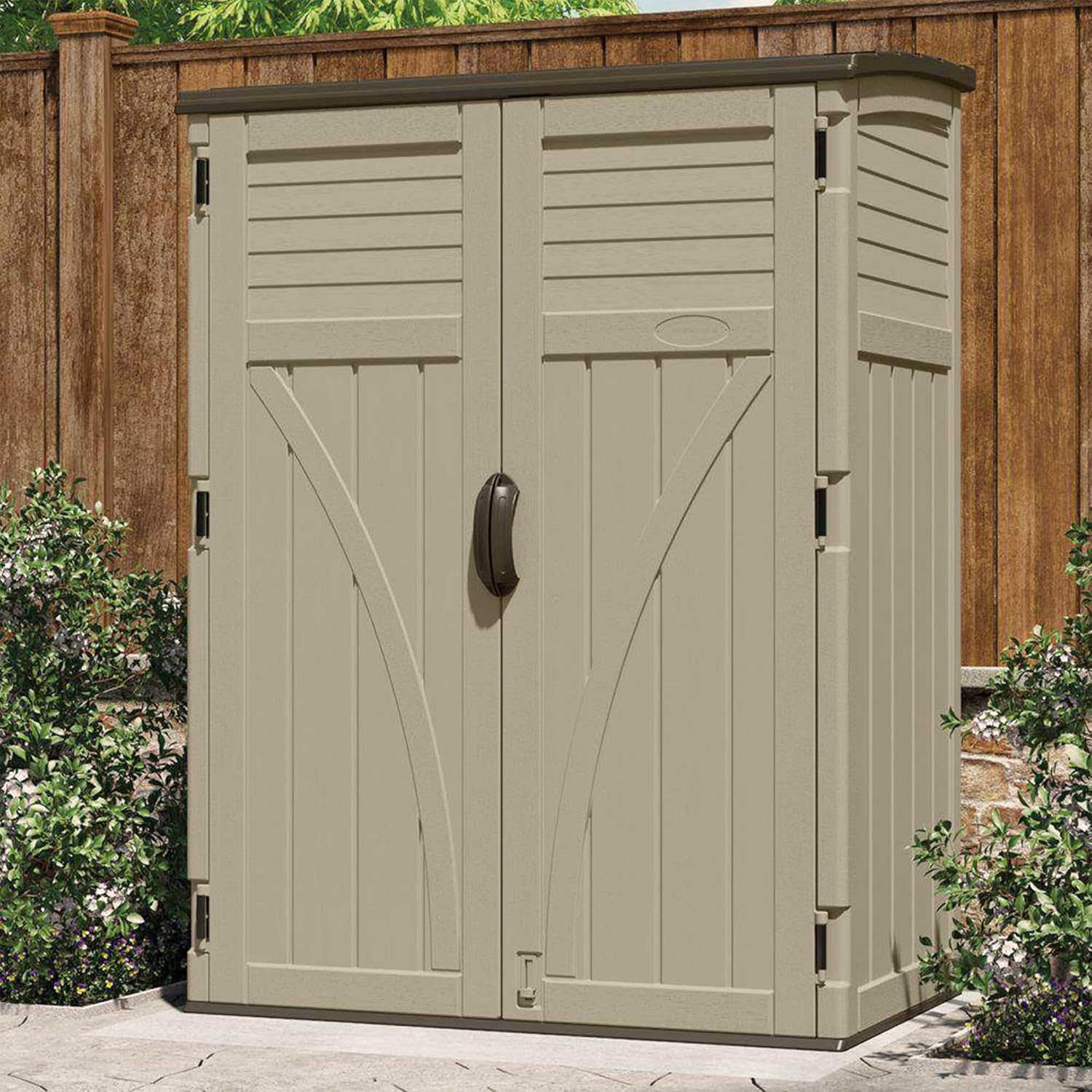
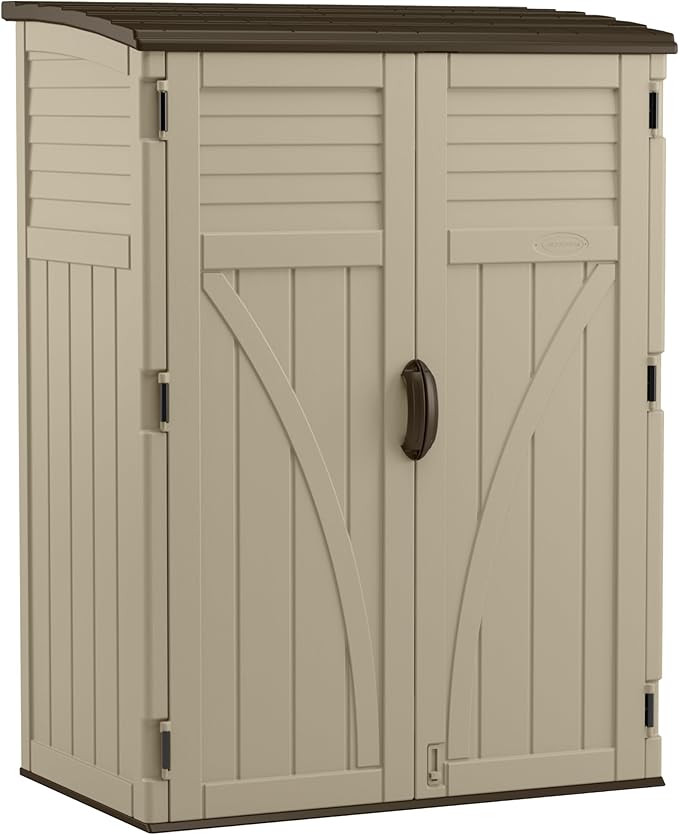
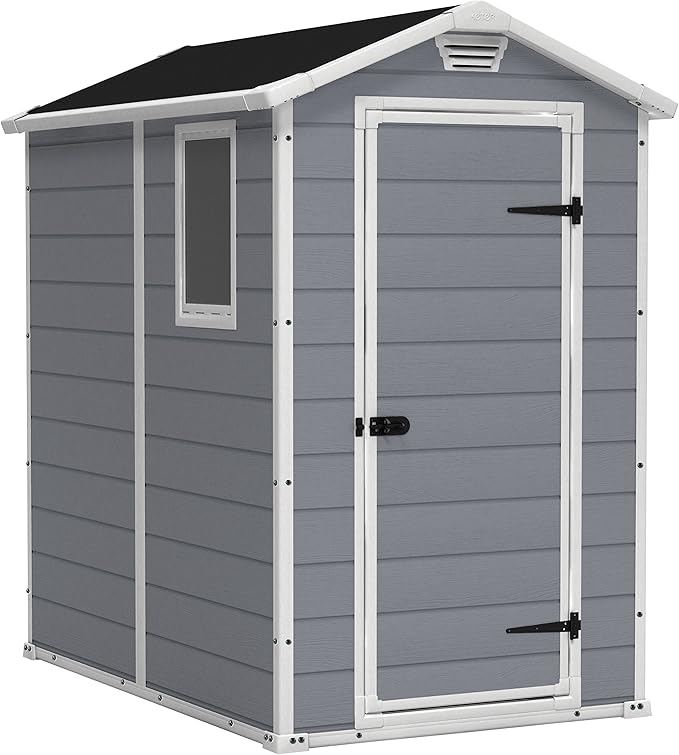
A walk-in shed needs door clearance on the swing side, a path to walk up to it, and enough room inside that reaching the back wall isn't a contortion act. On a 1,200 sq ft lot, all three cost you. A vertical shed pushes flat against a fence or the side of the house, opens outward in one sweep, and uses the wall behind it as free structural support. The Suncast 70 cu. ft. unit is the canonical example. Roughly 4 ft wide, 2.5 ft deep, and 6 ft tall, it claims a strip of yard most people are already wasting. The Keter Manor 4x3 ft is the same idea shaped like a cabin instead of a wardrobe, which is better if what you have is a corner rather than a strip.
Resin, steel, or wood
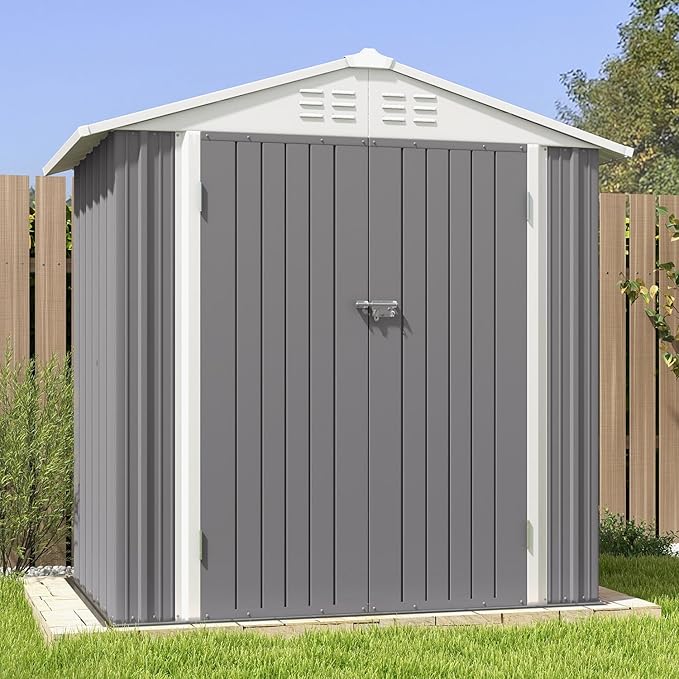
Resin (polyethylene) sheds own the small-yard category for good reason. They don't rust, they never need painting, and one person can usually put one together in an afternoon. The weakness is wind. An empty resin shed is light, and the wall panels flex more than steel in a gust, so anchoring isn't optional in any climate that gets storms. Steel sheds last longer in pure structural terms but rust at every screw hole the moment the powder coat gets scratched, and small-yard buyers rarely have a covered space to assemble them. Wood looks the best and rots the fastest unless it's on a proper slab with a drip edge. For most townhouse and condo buyers it's resin, and the only question left is which resin shed.
How much volume a starter household needs
A push mower, a string trimmer, a leaf blower, a rake, a snow shovel, a 2-gallon sprayer, and a bag of fertilizer fit in roughly 60 to 80 cu ft of vertical storage if the door pockets take the hand tools. Add bikes and that doubles. Add patio cushions for winter storage and you want a separate deck box rather than a bigger shed, because mixing chemicals with soft goods is a smell problem.
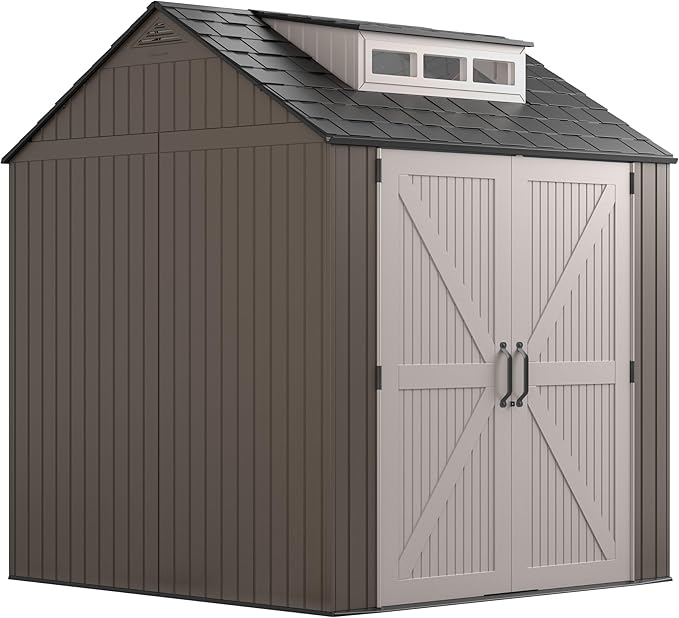
The Lifetime 8x5 ft unit goes somewhere else entirely. It's a small outbuilding, not an oversized cabinet. If the long-term plan involves a workshop corner or a potting station with a fold-down bench, the extra wall thickness and skylight panels earn their price. If the plan is just hiding lawn tools, it's overkill.
Floors, and why the cheap sheds skip them
Several entry-level resin sheds ship without a floor panel. The shed sits on whatever surface you put it on, which is fine on a poured slab and miserable on grass or pavers. With no floor, moisture wicks up into anything with cardboard packaging, bagged soil cakes into a brick, and ants treat the interior as outdoor space. Add the floor panel from the same product line if the listing sells one, or pour a small slab. The Keter Manor includes a reinforced floor. The Suncast verticals typically don't, and the upgrade is worth the $40 to 80 it adds.
Anchor the shed or lose it in a storm
An empty 70 cu ft resin shed weighs around 60 lbs. A 40 mph gust hitting 24 sq ft of wall surface generates more force than 60 lbs of inertia can resist, and the shed turns into a kite. Every manufacturer manual specifies an anchor kit, and almost nobody installs one on day one. Cheapest workable approach: two 40 lb tube sandbags dropped inside on the floor. Better: ground screws or concrete anchors through the molded base mounts. Best: a thin slab with anchor bolts embedded in it. On a $200 to 450 shed, $30 of anchoring hardware is the difference between still owning a shed in five years and replacing one after the next storm.
What separates the $200 picks from the $400 picks
The cheapest vertical resin sheds, under $200, skimp on wall thickness, hinge quality, and door seal. They do the job for a season or two, then the doors stop closing flush. The $200 to 300 bracket buys thicker walls and reinforced hinge cups. Above $400 you get either notably larger volume (the 70 cu ft Suncast) or genuinely heavier construction (the Lifetime, the bigger Keter Manors). For a small yard, $200 to 450 is the range to shop. Below that the construction is a gamble. Above it the shed is too big for the yard.
When a deck box beats a shed
If what you're storing is patio cushions, pool toys, kids' outdoor gear, or charcoal and grill accessories, a deck box does the job better. It opens from the top with one hand, fits against a railing without claiming yard space, and keeps soft goods away from anything that smells like gasoline. Put a vertical shed on tools and a small deck box on cushions and the storage problem is solved with two pieces that each cost less than one mid-sized shed.
Recommended
Products related to this guide.
Frequently asked questions
What are the best outdoor storage sheds for small yards?
Suncast 70 cu. ft. Vertical Storage Shed. The default answer when the only space you have is a 4x3 ft strip along a fence or against the house.
What are the best budget outdoor storage sheds for small yards?
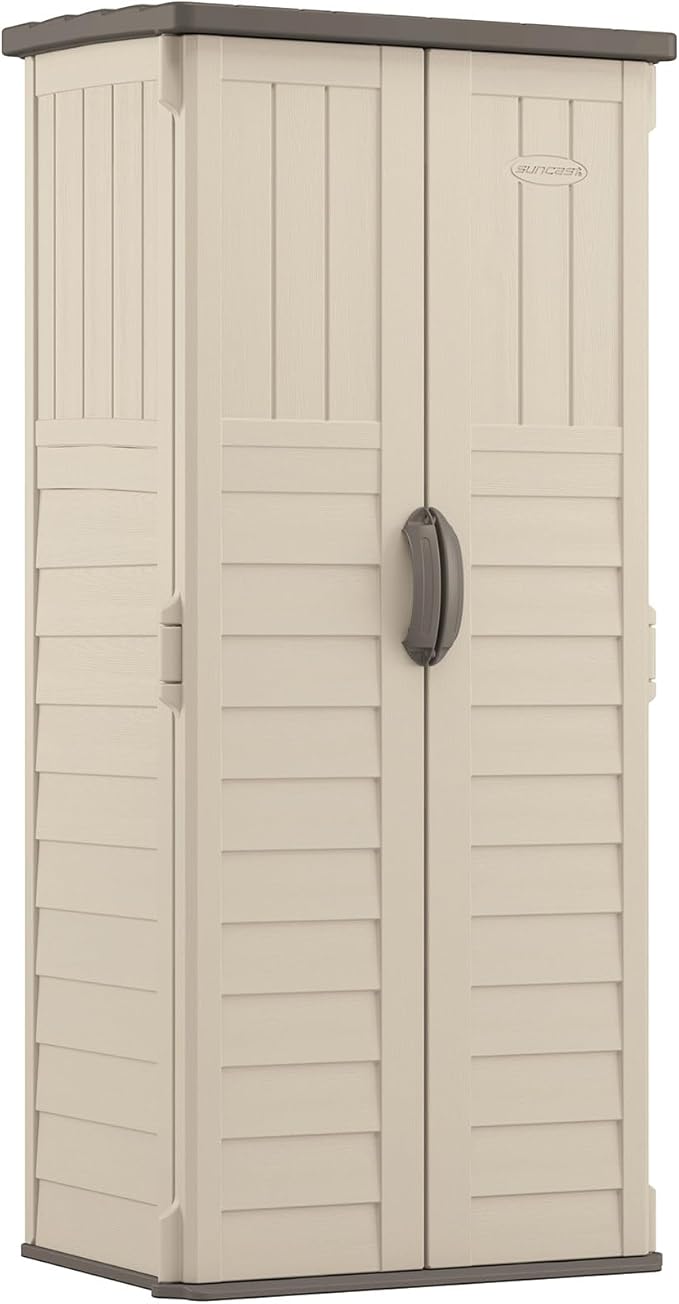
Suncast 22 cu. ft. Resin Vertical Outdoor Storage Shed. Half the volume of the top pick at half the price.
What are the best premium outdoor storage sheds for small yards?
Rubbermaid. Brand-name premium pick recommended by editorial review.