Restoration Hardware
RH Shelter Arm Sofa Reviews + Editorial Take
By Sam Hollis · Updated September 2026
Independent editorial review. We never accept payment for coverage, though we may earn a commission if you purchase through our links.
Verdict
There's minimal dedicated online discussion of the RH Shelter Arm (1950s Italian collection). The niche sculptural design pulls in committed buyers rather than casual shoppers, and post-purchase commentary is scarce. General RH sofa forums note that the brand's quality can vary by product line, and the Shelter Arm's sinuous spring construction sits below the Maxwell's eight-way hand-tied tier. The people who choose it are buying the distinctive curved-arm silhouette first and the construction spec second.
Read full take ↓Similar sofas
Quick Take
You pay Maxwell money and get sinuous springs instead of eight-way hand-tied, so what you are buying is the sculptural 1950s Italian arm rather than the suspension. The engineered hardwood frame with corner-blocked mortise-and-tenon joinery is built to hold that curved geometry over years. The lifetime guarantee and North Carolina build are real.
The distinctive RH piece that isn't the Cloud
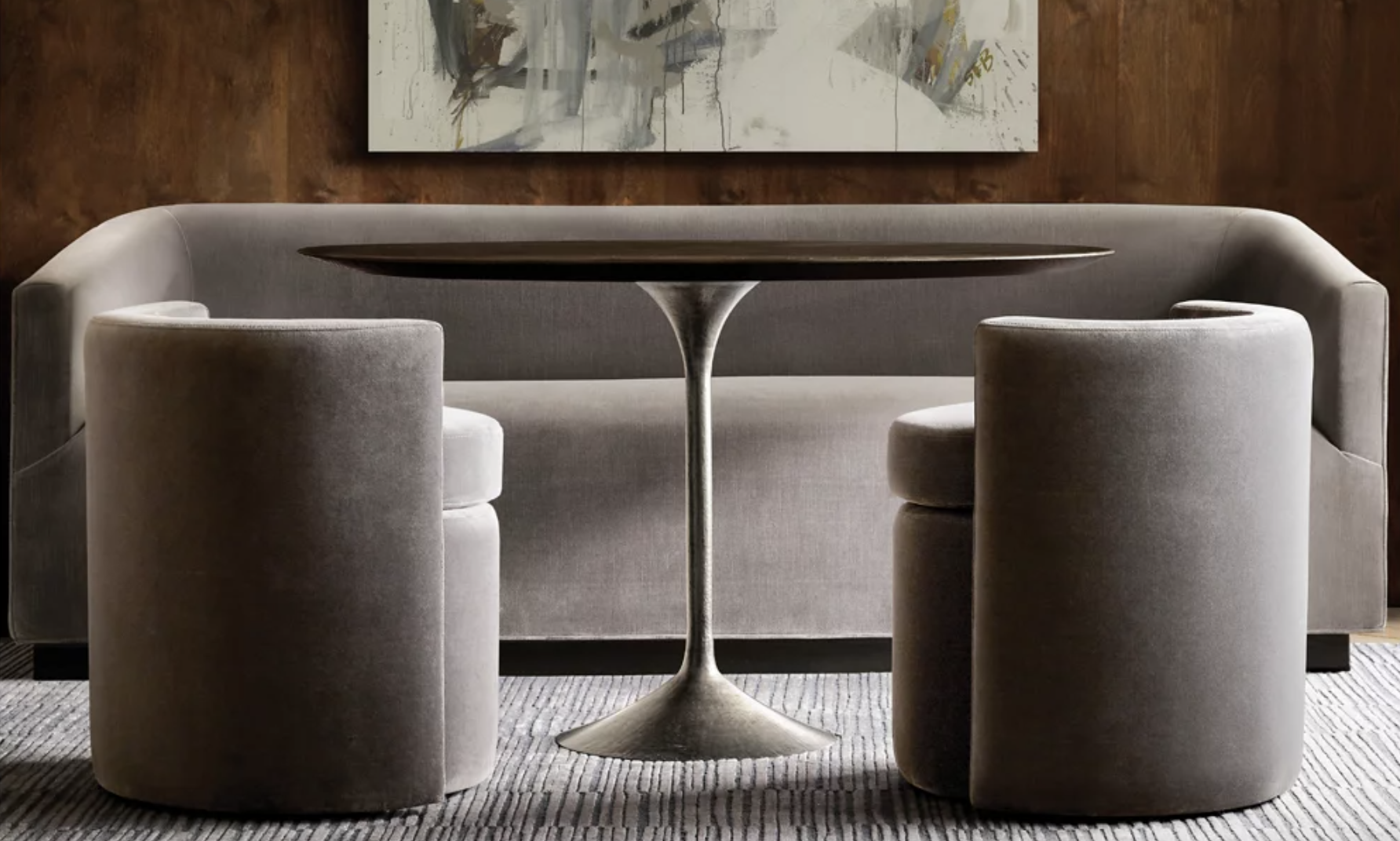
Within RH's upholstered furniture line, the Cloud takes the cultural attention and the Maxwell takes the practical recommendations. The Shelter Arm Sofa gets neither, and it deserves better. It's probably the most design-distinct piece in RH's current sofa lineup, with a curved arm profile that produces a cocoon quality nothing else at this price tier matches.
The shelter arm is the defining feature. Track arms are planar, rolled arms are cylindrical, and shelter arms arc inward from a broader outer edge to a narrower inner curve, wrapping a gentle embrace around the seating area. From across the room the effect is sculptural. The sofa reads as a considered object instead of a neutral background. Sit down and the arms create a sense of enclosure that feels genuinely different from a conventional sofa.
A profile that commands its space
This is not a wallflower piece. The curved arm profile reads visually larger than the sofa's actual dimensions, something several long-term owners raise in their reviews, usually as a thing they wish someone had warned them about. In a generously proportioned room with open space around it, the Shelter Arm fills that space with exactly the right kind of presence. In a small or tightly furnished room, it eats the room.
Sketch the furniture arrangement before you buy. The sofa needs breathing room at the sides and in front of it for the arm profile to read correctly. Pushed against a wall or hemmed in by other large pieces, the curved arms lose their visual impact and the whole thing feels compressed. Give it space and it's one of the most visually interesting sofas you can buy at retail.
Who this sofa is for
The Shelter Arm buyer wants a design statement that moves past "nice sofa" to "what is that sofa?" They're building a room around a point of view rather than around a neutral centerpiece. The curved arm works especially well among other organic or curved forms, rounded coffee tables, arc floor lamps, upholstered chairs with soft profiles. It also works as a counterpoint in rooms that deliberately set curved furnishings against rectilinear architecture.
It's the wrong piece for someone who wants to furnish a room without committing to a specific design direction. The Shelter Arm makes a commitment, and the room has to be ready to answer it.
Construction, and a cushion system with no daily upkeep
The Shelter Arm's standard suspension is heavy-gauge sinuous springs, with eight-way hand-tied offered as an upgrade. That is a step below the Maxwell's standard eight-way hand-tied build, but the sinuous system is firm and supportive and holds up well for the price. The foam-and-fiber cushion system asks nothing of you day to day. Seat and back cushions hold their shape through regular use without intervention.
The curved arm adds structural demands a flat arm profile doesn't have. Supporting that geometry complicates the frame work, and the upholstery of the inner arm curve, where fabric wraps a tighter radius, creates a wear point that deserves attention.
Inner arm wear
The curved inner arm surface takes more concentrated friction than a flat arm surface. When people rest a forearm while sitting, or grab the arm as a handhold when rising, the contact lands on the inner curve where the fabric radius is tightest. Multiple Shelter Arm owners with 3+ years of use report visible wear there before anywhere else on the sofa.
The reality is that it's preventable rather than inevitable. Keeping the inner arm surface clean, using armrest covers if you don't mind them, and picking a high-durability fabric grade at purchase all push the wear out considerably. In performance fabrics the issue is much less pronounced. In natural linen or standard weaves, plan for it.
Membership math and price justification
The Shelter Arm ranges from $3,295 to $5,600+ depending on configuration and fabric. Membership is mandatory and the math is simple: $175/year for 25% off. On a $4,000 Shelter Arm that's $1,000 saved, so the membership costs 17.5% of a single use. Buy the membership before you buy the sofa.
At membership-discounted prices between roughly $2,500 and $4,200, the construction, sinuous-spring suspension, high-resiliency foam cushions, RH's extensive fabric program, is reasonable value for someone who wants this particular design experience. The premium is real, and you should read it as payment for a distinctive design profile and a brand that will keep supporting the piece through its service life.
Fabric selection and the arm profile
Fabric choice changes how the signature detail reads more here than on most sofas. The curved arm is a three-dimensional form, and fabrics with pile or texture, performance velvet, boucle, heavier weaves, catch light differently on the outer and inner arm surfaces, which emphasizes the geometry. Flat, smooth fabrics quiet it down. If you want the arm profile to be the statement it's capable of being, go textured.
Color saturation matters too. Deep, saturated tones, forest green, inky navy, charcoal, terracotta, amplify the light-and-shadow play across the curved arm. Pale, low-contrast options mute it. No choice is wrong, but one is consequential: buy the Shelter Arm for its silhouette, then upholster it in a flat pale fabric, and you've partly cancelled out the thing that makes it distinctive.
How the Shelter Arm ages
The construction, sinuous-spring suspension, high-resiliency foam, and an engineered hardwood frame, is built for a long service life. Long-term owners at the four and five year mark report what Maxwell owners report: the seat feels unchanged, the frame is solid, and the maintenance burden is zero. The inner arm wear is fabric-dependent and manageable, and with performance fabrics it isn't a material concern inside a normal ownership horizon.
The design ages just as well. The shelter arm silhouette goes back far enough in furniture tradition that the trend cycle doesn't reach it the way it reaches more fashion-forward pieces. Commit to this sofa and it should stay right in your room for as long as the room keeps its general aesthetic direction, which for most buyers is a long time.
Frame engineering for a curved profile
Construction starts with an engineered hardwood frame with corner blocking and mortise-and-tenon joinery, the same quality baseline RH uses across its upholstered line. The curved arm brings structural demands a conventional straight-arm sofa never faces. The frame has to hold the arm's arc under outward pressure, and the joinery at the arm-to-back and arm-to-seat-rail connections is built to keep that geometry intact over years of use.
Sinuous spring suspension
The seat's standard suspension is heavy-gauge sinuous springs, S-shaped steel wires run front-to-back across the seat frame for firm, even support. RH offers eight-way hand-tied coil springs as an upgrade on this collection, the interconnected, cord-tied system that spreads weight across the whole network. The Maxwell ships eight-way hand-tied as standard; the Shelter Arm does not, so factor the upgrade in if hand-tied suspension is what you are after.
Whichever suspension you choose, the seat holds up over years of use. Sinuous springs give firm, consistent support, and the eight-way hand-tied upgrade adds the even, load-distributing feel that resists localized dead spots over time. Multiple Shelter Arm owners at the 5-year mark report unchanged seat feel.
Cushions
Seat and back cushions use high-resiliency foam cores wrapped in fiber batting. The foam specification lands medium-firm with a soft surface texture, a calibration that handles both upright sitting and lounging. The high-resiliency grade rebounds quickly after compression and resists permanent set across the sofa's service life. Nothing here needs daily maintenance, and cushions return to shape between uses on their own. If the Cloud's daily fluffing requirement is what scared you off, this cushion system removes that concern while still seating well.
Arm upholstery and wear considerations
The curved inner arm surface is a specific upholstery challenge. Fabric wraps a tighter radius on the inner curve than on the outer, and that surface takes concentrated friction from normal arm use. How it wears depends heavily on fabric selection. Performance fabrics, performance velvet and performance linen especially, carry higher rub counts (50,000-100,000+ double rubs) and resist the friction-driven wear at the inner arm curve much better. Standard linen and cotton weaves are beautiful and show inner arm wear sooner. On a sofa with this design feature, the performance fabric upgrade is the right call for anyone who plans to use it regularly for 5+ years.
Fabric options, configurations, and membership
The Shelter Arm comes in RH's full fabric library, hundreds of options across performance and standard weaves, velvet, natural fibers, and leather. The sculptural arm profile reads best in fabrics with some visual texture, and performance velvet and heavier weaves emphasize the arm geometry while flat, smooth fabrics understate it. Standard and grand configurations are both available. The RH annual membership ($175) gets you 25% off and should be bought before any RH transaction. Delivery is white-glove with full setup. RH's Lifetime Guarantee covers the frame, springs, and cushions for the original owner in residential use; the upholstery fabric is excluded.
Our Ratings
Overall score
An engineered hardwood frame with corner-blocked, mortise-and-tenon joinery, high-resiliency foam cushions, and a lifetime guarantee, all built to hold the curved arm's geometry over years of use. The one compromise for the price is sinuous springs instead of the eight-way hand-tied suspension the Maxwell gets as standard. Owners at the five-year mark report the seat feel unchanged.
No sofa in RH's lineup is more architecturally distinctive. The curved arm form makes a visual statement and changes how light moves across the piece. In a strong fabric it's the closest thing to furniture-as-art in the accessible luxury segment.
You pay Maxwell money but get sinuous springs instead of eight-way hand-tied, so what the Shelter Arm charges for is its sculptural 1950s Italian silhouette, not its suspension. The lifetime guarantee and North Carolina build are real, but factor the $175 RH membership into any comparison at this price.
What People Are Saying
There's minimal dedicated online discussion of the RH Shelter Arm (1950s Italian collection). The niche sculptural design pulls in committed buyers rather than casual shoppers, and post-purchase commentary is scarce. General RH sofa forums note that the brand's quality can vary by product line, and the Shelter Arm's sinuous spring construction sits below the Maxwell's eight-way hand-tied tier. The people who choose it are buying the distinctive curved-arm silhouette first and the construction spec second.
Reddit and Houzz commentary are weighted 3× against blog and editorial sources in our sentiment score. Brand PR has a well-documented influence on editorial coverage — direct owner reports from message boards tend to be more candid.
What Reddit Is Saying
“I have the RH 1950s Italian shelter arm sofa in velvet (scored it used on Facebook marketplace) and that shows no wear - the cushion looks perfect and we have a light green sage/mint velvet upholstery. We have a sectional in our family room from Hay (soft mags) that I also recommend. The RH sofa is comfortable (more so than it looks), but I don't know how it would be for TV watching, etc...but it will always look like no one has ever sat in it :)”View thread →
Frequently asked questions
Is the Restoration Hardware RH Shelter Arm Sofa worth it?
You pay Maxwell money and get sinuous springs instead of eight-way hand-tied, so what you are buying is the sculptural 1950s Italian arm rather than the suspension. The engineered hardwood frame with corner-blocked mortise-and-tenon joinery is built to hold that curved geometry over years. The lifetime guarantee and North Carolina build are real.
How is the Restoration Hardware RH Shelter Arm Sofa built?
An engineered hardwood frame with corner-blocked, mortise-and-tenon joinery, high-resiliency foam cushions, and a lifetime guarantee, all built to hold the curved arm's geometry over years of use. The one compromise for the price is sinuous springs instead of the eight-way hand-tied suspension the Maxwell gets as standard. Owners at the five-year mark report the seat feel unchanged.
What styles does the Restoration Hardware RH Shelter Arm Sofa work with?
No sofa in RH's lineup is more architecturally distinctive. The curved arm form makes a visual statement and changes how light moves across the piece. In a strong fabric it's the closest thing to furniture-as-art in the accessible luxury segment.
Options Worth Checking Out
More Restoration Hardware Reviews
See all →
More Sofas & Sectionals Reviews
See all →
How Does It Compare?
Side-by-side breakdowns featuring this product