Purple
Purple Mattress Review: The GelFlex Grid Is Real, But Is It Worth the Premium?
What Actually Makes the Purple Mattress Different
Purple has been selling the GelFlex Grid as a category-disrupting invention since 2016, and the honest assessment is that the technology is real and the marketing is also real. The grid is a hyper-elastic polymer construction that works differently from foam: when you apply pressure to a specific point, the grid columns in that area buckle and compress while the surrounding grid stays firm. This means the mattress can simultaneously relieve pressure at bony points like the hip and shoulder while supporting the spine across the broader surface. Foam achieves pressure relief through softness, which often means less support. The grid tries to achieve both at once through geometry rather than just material softness.
Whether this matters to you depends on your sleep profile. Hot sleepers benefit substantially from the grid because polymer does not trap heat the way memory foam does. The open-cell structure of the grid allows airflow through the sleep surface in a way that even gel-infused foam cannot fully replicate. Side sleepers with hip and shoulder pressure issues also tend to respond positively to the grid because the localized buckling relieves pressure without creating the full-body sink of a very soft foam mattress. Back and stomach sleepers with normal body temperature and no specific pressure-relief needs will likely not notice the grid advantage over a quality foam hybrid at the same price.
The Purple 4 vs. the Original Purple: What You Are Actually Choosing
The original Purple (now sometimes called the Purple Plus) uses the 2-inch GelFlex Grid with foam support layers but no coil base. The Purple 4 adds a 4-inch grid layer and a pocketed coil base, making it a hybrid rather than a pure foam-and-grid construction. The coil base improves edge support and durability, which are the two weakest points of the original. The 4-inch grid also enhances the pressure-relief effect, particularly for heavier sleepers. The price difference is significant: the Purple 4 runs roughly $600 to $800 more than the original for a queen.
Most reviews recommend the Purple 4 if you are going to buy Purple at all, specifically because edge support on the original is weak enough to be a real daily-use issue. If you sit on the edge to get in and out of bed, the original model compresses significantly. The Purple 4 with its coil base handles this much more competently.
Where Purple Loses the Comparison to Tuft and Needle and Helix
The honest value comparison is difficult for Purple because the grid technology is proprietary and does not translate directly to competing specs. Tuft and Needle Original at $375 to $649 offers none of the grid technology but costs a third of the price. Helix Midnight Luxe at a similar price to the Purple 4 offers a more conventional but well-engineered hybrid with better long-term owner satisfaction data and a stronger customization story for couples.
Purple earns its position specifically for buyers who run hot and who have tried other mattresses and found them too warm. If that is your primary complaint about your current mattress, Purple is worth the premium because no other construction addresses airflow as directly. If your primary concern is back support, value, or durability, Purple is harder to recommend over the alternatives.
Owner Polarization Is a Real Signal
Purple has more polarized ownership data than most mattresses in this price tier. Owners who love it tend to be hot sleepers or people with shoulder and hip pressure issues who tried foam alternatives without success. Owners who dislike it tend to cite the unusual feel of the grid as disorienting, the edge support problems on the original model, and the price relative to what they got. This is not a mattress that produces moderate opinions. If the grid solves your problem, you will love it. If it does not solve a specific problem you have, you will wonder what you paid for.
The 100-night trial is standard for the category. Purple processes returns without significant issues based on owner reports, though the mattress requires two people to repackage for pickup. The 10-year warranty is standard for the category and is not a differentiator for Purple in either direction.
The GelFlex Grid: How It Actually Works
The GelFlex Grid is a hyper-elastic polymer grid designed to flex under localized pressure while remaining supportive across the broader surface. Purple holds patents on the grid geometry and manufacturing process. The 2-inch grid in the original Purple uses a honeycomb-style column pattern. The 4-inch grid in the Purple 4 uses a wider, taller column pattern that amplifies the pressure-relief effect. Polymer does not compress over time the way foam does, which is Purple's argument for long-term durability of the comfort layer.
Support Layers and Firmness
Beneath the grid: the original Purple uses a standard polyfoam transition layer and a high-density polyfoam base. The ILD equivalent of the overall feel is approximately medium (around 5 on a 1-10 firmness scale), though the grid does not behave like foam and ILD comparisons are not perfectly applicable. The Purple 4 adds a pocketed coil base beneath the foam layers, which significantly improves edge support and overall durability compared to the foam-only original.
Heat Retention
The open-grid construction does not trap heat because airflow can move through the grid laterally and vertically. Purple markets this aggressively and the claim holds up in both independent tests and owner reports. Hot sleepers consistently rank Purple among the top performers for temperature regulation, outperforming gel-infused foam alternatives and most hybrid designs without cooling covers.
Trial and Warranty
The trial period is 100 nights across all Purple models. The warranty is 10 years and covers sagging over 1 inch. This is standard for the DTC mattress category. The original model requires two people to lift and fold for a return because it does not compress back to box size without equipment.
Our Ratings
Overall score
The proprietary GelFlex Grid is a genuinely novel construction: a hyper-elastic polymer grid that buckets under pressure points while providing firmness across the broader sleep surface. It is unlike foam in a way that is not just marketing, but the supporting foam layers beneath the grid are standard-grade and the coil base in the higher models is a fairly conventional pocketed coil system.
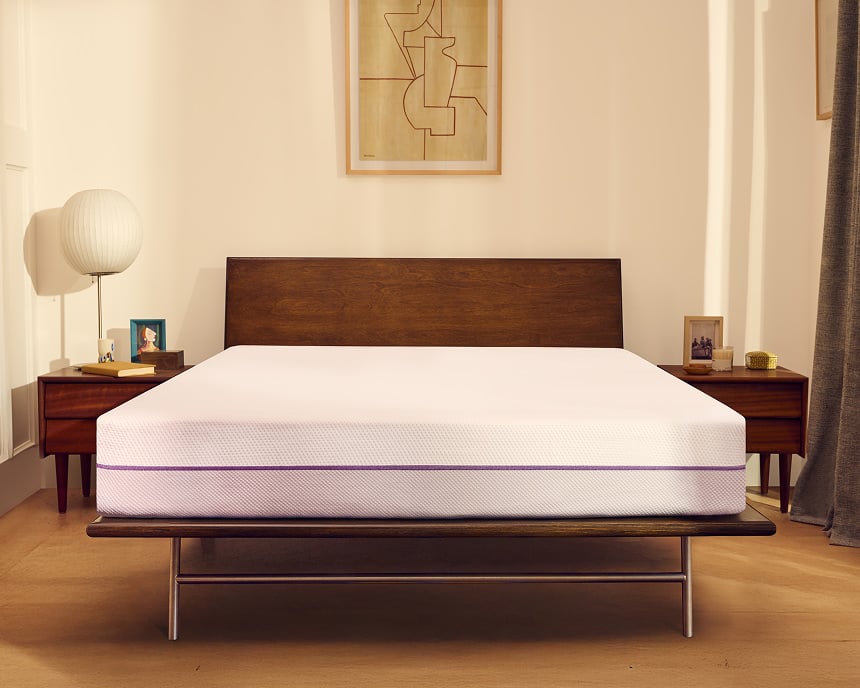
The Purple cover is functional and clean but unremarkable. The gray and purple branding aesthetic is distinctive enough to recognize from across a room, which is fine if you use a mattress cover and irrelevant if you do not. There is no premium finish quality story here; the visual design is clearly secondary to the construction technology.
At $1,299 to $2,399 for a queen depending on the model tier, Purple is priced above Tuft and Needle and Nectar but below Saatva and WinkBed. The GelFlex Grid is proprietary and genuinely differentiated for hot sleepers, but buyers who do not run hot or who do not need the specific pressure-relief profile of the grid will find better value elsewhere at this price.
What People Are Saying
Purple owner sentiment is sharply divided. Hot sleepers and side sleepers with pressure issues are consistently among the brand's strongest advocates. Owners who expected a conventional mattress feel are often put off by the unusual tactile sensation of the grid, which some describe as sleeping on a cool, firm surface rather than being cradled. Edge support complaints are common for the original model.
What Reddit Is Saying
“I tried four mattresses in three years, all foam or hybrid, and I woke up hot on all of them. The Purple 4 is the first mattress I have slept through the night without waking up sweating. The grid technology is real.”View thread →
“Side sleeper, 175 pounds, significant hip pain on most mattresses. The Purple 4 is the only mattress I have tried that relieves the pressure without making me feel like I am sinking. Worth every dollar for my specific situation.”View thread →
“I have a medical history of night sweats. Every foam mattress I owned made it worse. The Purple is the only DTC mattress that actually addresses heat retention at a structural level rather than just adding a gel layer on top of hot foam.”View thread →
“There are three people in my house who sleep on different mattresses. My partner and I both tried the Purple original. She loved it, I did not. The same mattress gets very different reactions from different people.”View thread →
“My wife loves the Purple 4. I am neutral on it. The feel is just unusual enough that I never fully stopped noticing I was sleeping on something different. Neither of us hates it, but only one of us truly loves it.”View thread →
“The grid feels weird. I know that is subjective but after a month I still felt like I was sleeping on a novel material rather than a mattress. Returned it and went back to a traditional innerspring.”View thread →
“For the price, I expected more from the base construction. The grid is interesting but the support layers under it are nothing special. A Helix or even a WinkBed gives you more construction per dollar.”View thread →
“The original Purple has almost no edge support. I sit on the side every morning to put on socks and the mattress compresses completely. If they had said that upfront I would have ordered the Purple 4 instead.”View thread →
What Others Are Saying
“The GelFlex Grid consistently outperforms foam alternatives in temperature regulation testing. Hot sleepers and side sleepers are the strongest candidates for the Purple line, particularly the Purple 4 with its coil base.”Source →
“In our temperature testing, the Purple GelFlex Grid outperformed every foam mattress we tested and most hybrid designs. For sleepers whose primary concern is heat retention, it is the best mainstream option available.”Source →
“The Purple 4 addresses the edge support weaknesses of the original model substantially. Buyers who are considering the original Purple should seriously evaluate whether the $600 to $800 upgrade to the Purple 4 is worth it for the improved coil base.”Source →
“Purple is an unusual product in an industry full of similar foam constructions. The grid technology is real and the heat regulation advantage is legitimate. The value case is harder to make for buyers who do not specifically run hot.”Source →
“The original Purple has edge support that we would characterize as below average for the price. We recommend the Purple 4 specifically for buyers who sit on the edge of the bed regularly or who share the bed and use the full surface width.”Source →
“Purple owner satisfaction scores are more variable than most top-tier mattress brands. The grid generates strong loyalists and genuine skeptics in roughly equal measure, which suggests the product works very well for specific sleeper types and less well for others.”Source →
“Purple's 100-night trial is shorter than Saatva's 365-night option and matches the standard DTC benchmark. The 10-year warranty is industry-standard and does not give Purple a competitive advantage over Nectar or Casper.”Source →
“Compared to Tuft and Needle at a fraction of the price, the Purple grid offers real advantages for specific sleepers. The question for most buyers is whether their specific sleep profile justifies the substantial price difference.”Source →