KitchenAid
KitchenAid Artisan Review — The Stand Mixer That Lasts 30 Years?
By Maya Chen · Updated September 2026
Independent editorial review. We never accept payment for coverage, though we may earn a commission if you purchase through our links.
Verdict
A focused review of the KitchenAid Artisan KSM150PS: what the 5-quart tilt-head actually does well, where the 325W motor and plastic gear hit limits.
Similar alternatives
Quick Take
at the $449 to $499 street price, the KitchenAid Artisan KSM150PS earns it for home bakers who use a mixer weekly, who want the attachment hub ecosystem (pasta roller, meat grinder, ice cream maker), and who want a machine that can sit on the counter for 15 to 30 years without looking dated. It doesn't earn it for someone who bakes twice a year, for serious high-hydration bread bakers who need the bowl-lift Pro 5 Plus, or for anyone whose real want is the cheapest decent stand mixer, which is the Cuisinart SM-50 at $230.
The 30-year heirloom claim is true with conditions. Older all-metal Artisans (pre-2010) genuinely run for decades. Newer units use a nylon worm gear built in as a sacrificial part, replaceable for $15 in parts and an hour of work, and repair shops confirm the gear is the most common failure and the easiest fix. The motor, casting, and attachment hub still outlast the kitchen. Color selection is why this product holds its price: 40+ finishes, and no other stand mixer doubles as decor.
One product here: the KitchenAid Artisan KSM150PS, the 5-quart tilt-head stand mixer that has been the default wedding-registry pick in American kitchens for the better part of two decades. Every shopper asks the same question at $449 to $499, so that's the one this review answers. Is it worth the money, or does the $230 Cuisinart SM-50 get you close enough?
The Artisan is the mid-tier of KitchenAid's tilt-head line. Below it sits the Classic K45SS at roughly $300; above it, the bowl-lift Pro 5 Plus at roughly $550. The Artisan splits the difference: a 5-quart stainless bowl, a 325-watt motor, the PowerHub attachment port that fits 15+ KitchenAid accessories, and a color program running past 40 finishes. Everything else in this review is about whether the motor, the gear design, and the brand premium are worth roughly $220 over the Cuisinart, and what that 'lasts 30 years' reputation looks like in practice in 2026.
The machine itself
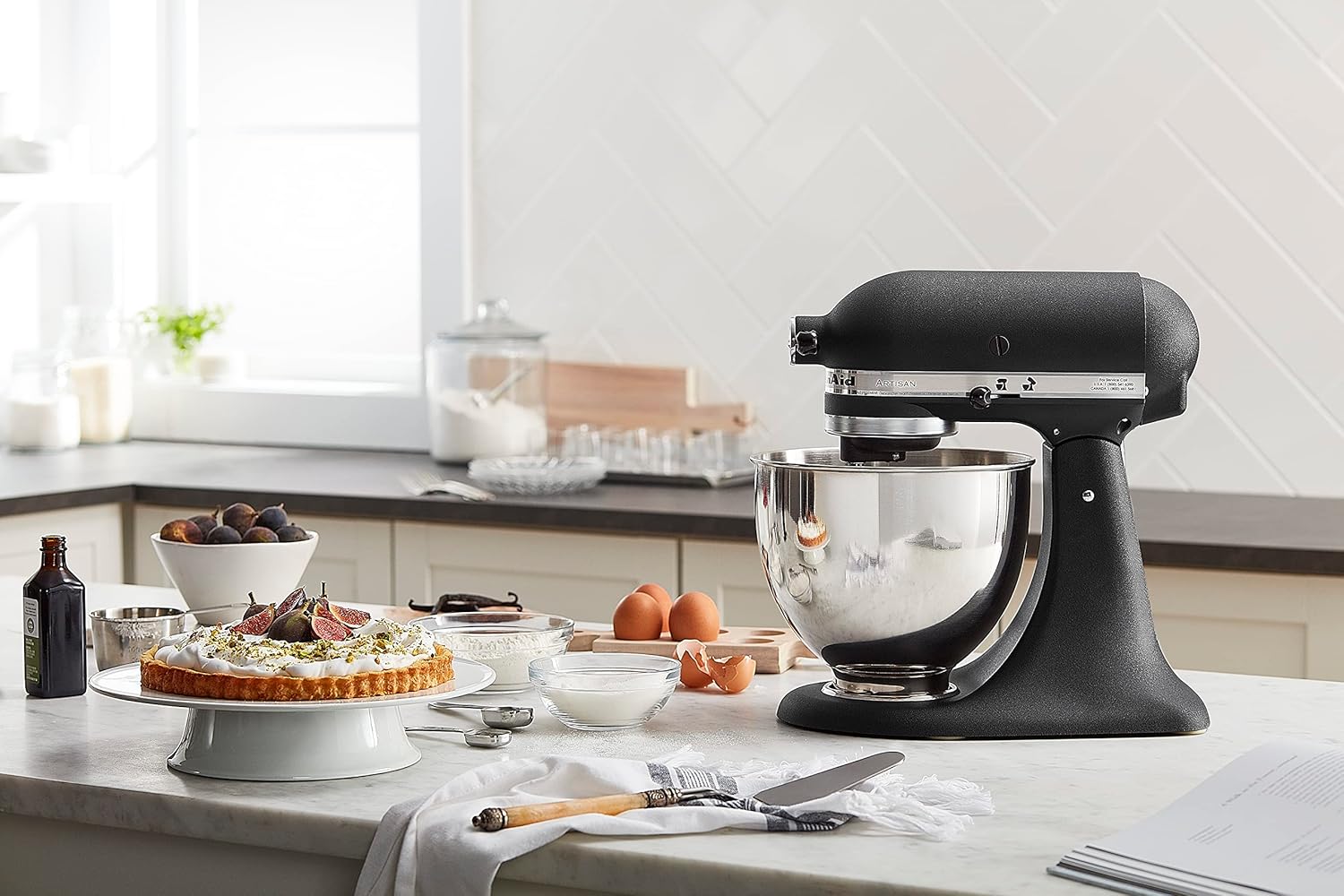
The Artisan KSM150PS is a 5-quart tilt-head stand mixer with a 325-watt DC motor, a 10-speed planetary mixing action, and a PowerHub attachment port on the front. The head tilts back to free the bowl instead of the bowl dropping away on a lift mechanism. Standard kit: a coated flat beater, a coated dough hook, a wire whip, and a pouring shield. The bowl is stainless steel with a handle. Weight is roughly 26 pounds, heavy enough that most owners leave it on the counter rather than wrestle it into a cabinet.
The 5-quart capacity handles about 9 cups of flour or 8 dozen cookies per batch, per KitchenAid's spec page. That covers almost any home baking job short of large-batch bread or wedding-cake work. The PowerHub takes attachments from KitchenAid's catalog: pasta roller, meat grinder, ice cream maker, vegetable sheet cutter, grain mill, and spiralizer, among others. This ecosystem is the lock-in. Once you own three attachments, switching to another brand means rebuying all of them.
What the Artisan does well
Build quality first. The motor housing and base are die-cast metal, not plastic, which is why a 26-pound mixer feels like a tool rather than an appliance. The tilt-head locks firmly, the speed dial has the right amount of friction, and the planetary action covers the bowl thoroughly. Owners who buy used Artisans from the 1990s and 2000s routinely report them still running with no service. The casting and the motor outlast the decor around them.
The attachment hub is the second win. The PowerHub design hasn't changed since the 1930s, so an attachment bought in 1980 fits a mixer bought in 2026. Owners who run the pasta roller weekly, or grind their own meat, or make ice cream every summer, get more out of that single port than out of the mixer itself. It is the strongest argument against switching to any competitor.
Color selection is underrated here. KitchenAid sells the Artisan in more than 40 finishes, refreshed seasonally, including mattes, metallics, and the annual Color of the Year. No other stand mixer is built as countertop decor, and that's why resale value on used Artisans holds up better than any other small appliance. A 10-year-old Artisan in a color people want still sells for $250 on the secondary market.
Day-to-day performance is solid at the bread, cookie, cake, and frosting work most home bakers bought a stand mixer for. The 10-speed range runs from a slow stir-in for dry ingredients up to a stiff-peak whip, the bowl-and-beater geometry catches the sides without much scraping, and the splash guard finally became useful after a 2018 redesign. The mixer isn't silent, but it's noticeably quieter than the Pro 5 Plus bowl-lift.
Where the Artisan hits limits
High-hydration bread dough is the limit you'll hear about most. The 325-watt motor and the nylon worm gear can't take the sustained load of kneading 80% hydration sourdough or large double-batches of pizza dough. KitchenAid's own spec caps the Artisan at 9 cups of flour at a time and points serious bread bakers to the bowl-lift Pro 5 Plus or Pro 600. Push past that and you become the owner burning out gears.
The nylon worm gear deserves its own conversation before you buy. Starting in the mid-2000s, KitchenAid moved from an all-metal gear train to a design that includes a nylon worm gear as a sacrificial part. The logic holds up: overload the mixer and the $15 nylon gear dies before the motor does. The feeling is worse if you expected an heirloom appliance, since the gear can wear out in 5 to 10 years of heavy use. Repair shops confirm it is the most common Artisan failure and the easiest one to fix. KitchenAid sells the part, and replacement runs roughly an hour of work.
Bowl capacity is the third limit. The 5-quart bowl is enough for most batches, but the working capacity, meaning what the beater reaches without splash, is closer to 4 quarts. Doubling a cookie recipe routinely sends flour over the top before the splash guard is fitted, and frosting a wedding-quantity cake means batching. Owners cooking for 10+ people tend to trade up to the 6-quart Pro 5 Plus inside a year.
Bowl-handle ergonomics are a small but real complaint. Tilt-head means you pull the bowl up and out rather than swinging it down on a lift. With a heavy batter that lift is awkward, and owners with wrist trouble say it is the reason they switched to the Pro 5 Plus. It's a quiet ergonomic cost the marketing never mentions.
The 30-year heirloom claim, qualified
The 30-year heirloom claim is mostly true and worth taking seriously, with three qualifiers. The first is generation. Pre-2010 Artisans with all-metal gear trains are the ones that keep showing up still working at 25 and 30 years. Post-2010 units with the nylon worm gear can go that far too, but expect at least one gear replacement somewhere in the run.
The second qualifier is workload. An Artisan used twice a month for cookies and frosting will outlive its owner. An Artison used twice a week for sourdough at maximum capacity needs a gear replacement in 5 to 10 years and a motor rebuild somewhere in the second decade. KitchenAid's spec sheet is honest about the intended workload, and the 30-year claim assumes you're mixing within it.
The third qualifier is repair access. Independent KitchenAid repair shops still operate in most US metros, parts come straight from KitchenAid, and YouTube tutorials cover the common fixes. The product is repairable in a way most modern appliances aren't. If 'lasts 30 years' means to you 'runs for 30 years without ever being opened,' the claim oversells. If it means 'is still around and serviceable in 30 years,' it's accurate, and that's what buyers are paying the premium for.
Who the Artisan KSM150PS is for
Home bakers who use a mixer weekly are the clearest yes. Cookie batches, cake batter, frosting, single-batch pizza dough, and whipped cream are the work this machine was engineered around. At weekly use the build quality earns the price tag and the gear design holds up indefinitely.
Anyone planning to use the attachment ecosystem is the second clear yes. Pasta makers, meat grinders, ice cream makers, and vegetable spiralizers all get materially better when they share a single base. Against a standalone pasta machine or food grinder, the math swings hard toward the Artisan once you own two or three attachments.
Buyers who care how the kitchen looks are the third yes. That isn't a small consideration. The Artisan sits on the counter for 20 years, and the color selection is why it doesn't look dated in year 10. If the alternative is hiding a beige mixer in a cabinet, pay the premium.
Who should skip the Artisan
Occasional bakers, the twice-a-year holiday crowd, should skip it. A $449 mixer that runs three times a year is a $150-per-use appliance. The Cuisinart SM-50 at $230, or a hand mixer at $40, is the honest answer for that workload. The Artisan was never meant to sit in a cabinet for 11 months. It's meant to earn its counter space.
Serious sourdough and high-hydration bread bakers should step up to the Pro 5 Plus rather than down to the Artisan. The bowl-lift design, the 525-watt motor, and the all-metal gear train of the Pro 5 Plus are the difference between a mixer that survives your weekly loaves and a mixer that breaks in a year. The $100 premium over the Artisan pays for itself the first time you mix a double-batch of 80% hydration dough.
If what you want is 'a decent stand mixer for occasional use,' buy the Cuisinart SM-50. It's well-built, the bowl holds 5.5 quarts, and it costs $150 less than the Artisan. You give up the attachment ecosystem (Cuisinart's catalog is thin), the color selection (mostly silver and white), and the resale value (close to zero). For a buyer who would otherwise leave the Artisan in a cabinet, the SM-50 is the honest pick.
Where the other stand mixers land
The KitchenAid Pro 5 Plus KV25G0X at roughly $550 is the step-up for serious bread bakers: bowl-lift design, 5-quart bowl, 525-watt motor, all-metal gear train, and the same PowerHub attachment ecosystem. It's louder and uglier than the Artisan and the color selection is limited, but it handles workloads the Artisan can't. The right pick if you bake high-hydration bread weekly.
The Cuisinart SM-50 at roughly $230 is the honest mid-budget alternative for occasional bakers. 5.5-quart bowl, 500-watt motor, 12 speeds, splash guard included. The build goes plastic where the Artisan is metal, the attachment ecosystem is much thinner, and the resale value is effectively zero. If you're honest that the mixer comes out six times a year, this is the right answer.
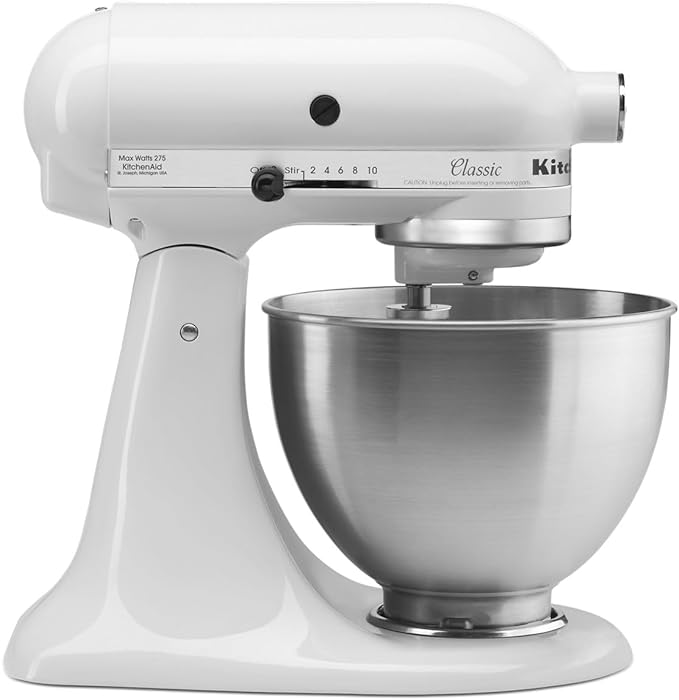
The KitchenAid Classic K45SS at roughly $300 to $400 is the budget KitchenAid pick. 4.5-quart bowl, same tilt-head design, same PowerHub port as the Artisan, but a 250-watt motor and a limited color selection (mostly white, black, and silver). Functionally close to the Artisan for most home tasks; the gap is finish options and small capacity differences. The Artisan is the one to get if you want a KitchenAid for the attachment ecosystem and don't need the Artisan's color program or the extra half-quart.
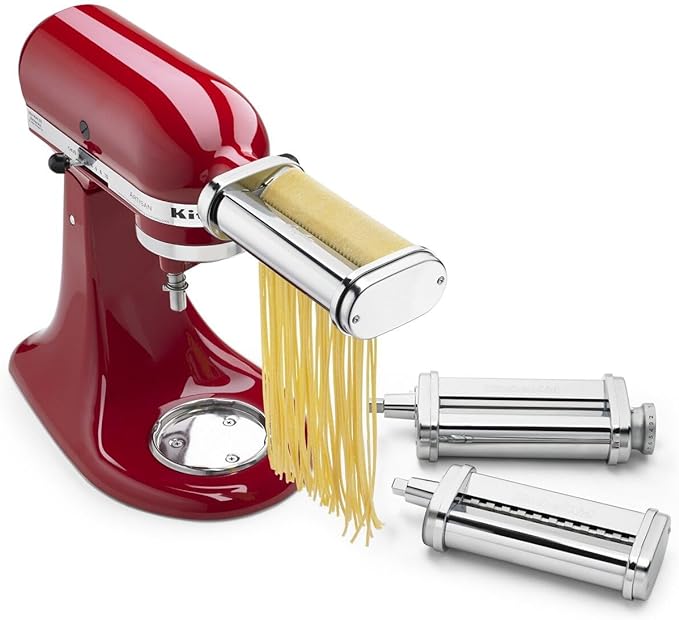
The Pasta Roller and Cutter Set (KSMPRA) is the companion that makes the case for the KitchenAid ecosystem in the first place. Three-piece set: a sheet roller, a spaghetti cutter, and a fettuccine cutter. Fits any KitchenAid tilt-head or bowl-lift through the PowerHub. Materially better than a standalone hand-crank pasta machine because the mixer drives the rollers at constant speed.
The verdict on $449
The KitchenAid Artisan KSM150PS earns its $449 to $499 if you bake weekly, if you plan to own at least one attachment, or if the mixer is going to be visible on your counter for the next decade. In those cases the build quality, the attachment hub, and the color program justify the premium over the Cuisinart, and the long repair tail justifies it over every other brand.
Occasional bakers shouldn't pay $449; buy the Cuisinart SM-50. Serious bread bakers shouldn't either; step up to the Pro 5 Plus. And if the only Artisan feature you want is the brand name in white or silver, the Classic K45SS gets you 90% of the way there for $150 less. The buyer in the middle is the one this machine fits: weekly home baking, color matters, attachments are part of the plan.
Our Ratings
Overall score
Real heirloom hardware at a mid-tier price: a 325-watt DC motor drives 10-speed planetary action through a cast metal housing and die-cast zinc gearbox, and the PowerHub front port hasn't changed since the 1930s, so any KitchenAid attachment from the last 90 years still fits. The honest caveat is the nylon worm gear in post-2010 units, a sacrificial part that repair shops confirm is the most common failure and a $15, one-hour fix.
The only stand mixer that doubles as kitchen decor: every competitor copies the tilt-head silhouette, and this is the one they copied. KitchenAid sells more than 40 finishes, from Empire Red and Pistachio to brushed metal and matte black, which is why buyers leave it on the counter instead of hiding it in a cabinet. A 15-year-old Artisan in a discontinued color still pulls $200 on eBay.
Fair if you bake, harsh if you don't. At $449 for a machine that runs 15 to 30 years, you're paying $15 to $30 a year, well under what a weekly baker spends on bench gear, and the attachment ecosystem deepens that value once you own two or three accessories. The twice-a-year baker does better with the Cuisinart SM-50 at $230, and serious high-hydration bread bakers should step up to the bowl-lift Pro 5 Plus.
KitchenAid Artisan on Amazon.
Frequently asked questions
Is the KitchenAid Artisan worth it?
at the $449 to $499 street price, the KitchenAid Artisan KSM150PS earns it for home bakers who use a mixer weekly, who want the attachment hub ecosystem (pasta roller, meat grinder, ice cream maker), and who want a machine that can sit on the counter for 15 to 30 years without looking dated. It doesn't earn it for someone who bakes twice a year, for serious high-hydration bread bakers who need the bowl-lift Pro 5 Plus, or for anyone whose real want is the cheapest decent stand mixer, which is the Cuisinart SM-50 at $230. The 30-year heirloom claim is true with conditions.
How is the KitchenAid Artisan built?
Real heirloom hardware at a mid-tier price: a 325-watt DC motor drives 10-speed planetary action through a cast metal housing and die-cast zinc gearbox, and the PowerHub front port hasn't changed since the 1930s, so any KitchenAid attachment from the last 90 years still fits. The honest caveat is the nylon worm gear in post-2010 units, a sacrificial part that repair shops confirm is the most common failure and a $15, one-hour fix.
What styles does the KitchenAid Artisan work with?
The only stand mixer that doubles as kitchen decor: every competitor copies the tilt-head silhouette, and this is the one they copied. KitchenAid sells more than 40 finishes, from Empire Red and Pistachio to brushed metal and matte black, which is why buyers leave it on the counter instead of hiding it in a cabinet. A 15-year-old Artisan in a discontinued color still pulls $200 on eBay.
Options Worth Checking Out
KitchenAid Professional 5 Plus KV25G0X Bowl-Lift Stand Mixer
The step-up for serious bread bakers. Bowl-lift design, 525W motor, all-metal gear train, same PowerHub ecosystem. Louder and uglier than the Artisan with thinner color options, but handles high-hydration doughs and double-batches the Artisan cannot.
Cuisinart Stand Mixer, 12 Speeds, 5.5-Quart
The honest mid-budget alt for occasional bakers. 5.5-quart bowl, 500W motor, 12 speeds. Plastic where the Artisan is metal, thin attachment catalog, near-zero resale. Right pick for the buyer who would otherwise leave a KitchenAid in the cabinet.
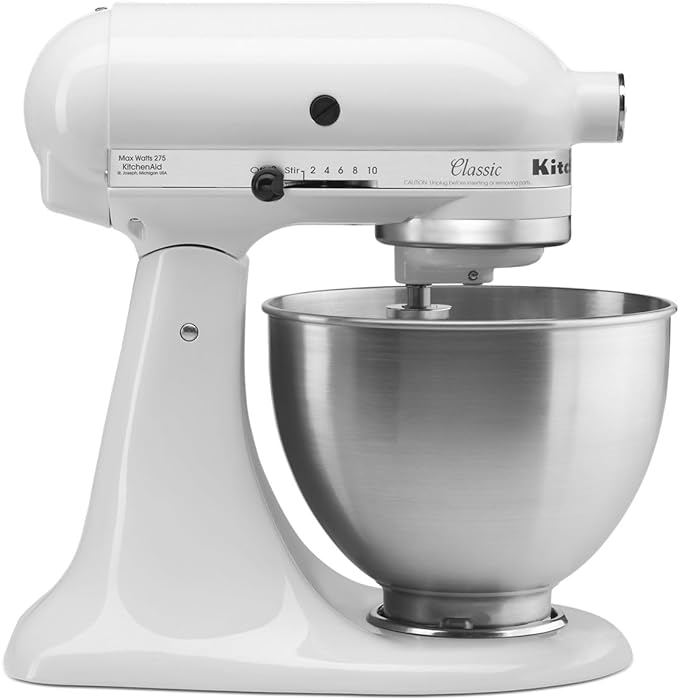
KitchenAid Classic K45SS 4.5-Quart Tilt-Head Stand Mixer
The budget KitchenAid pick. Same tilt-head and PowerHub port as the Artisan with a 4.5-quart bowl and 250W motor. Limited color choice (white, black, silver). 90% of the Artisan for $150 less if you don't need the color program.
You Might Also Need
Accessories worth grabbing alongside your purchase