Instant Pot
Instant Pot Pro Review — Worth $170 Over the Duo?
By Erin Mitchell · Updated September 2026
Independent editorial review. We never accept payment for coverage, though we may earn a commission if you purchase through our links.
Verdict
A focused review of the Instant Pot Pro 10-in-1: what the 28 customizable programs and NoiseReduction steam diffuser actually deliver.
Similar alternatives
Quick Take
The Instant Pot Pro is worth $170 if you use the customizable programs, if you cook in the kitchen often enough that the quieter NoiseReduction steam diffuser matters, or if you've already worn out a previous-generation Duo and want the upgrade. It isn't worth $170 if you mostly press one button (rice, soup, pressure cook) and walk away. In that case the $120 Duo Plus does the same job and the $90 base Duo does roughly 80% of the job for half the price.
The premium comes down to two real upgrades. The NoiseReduction steam diffuser drops the venting hiss from startle-the-dog loud to dishwasher loud, which is the single most common complaint about every other Instant Pot. The 28 customizable programs (save your own time, temperature, and pressure for favorites) genuinely help if you cook the same five things on rotation. Everything else, the heavier inner pot, the brighter display, the redesigned handles, is incremental and not worth $50 by itself.
One product, one question. The Instant Pot Pro is the $170 10-in-1 multicooker at the top of Instant Brands' consumer lineup, and the question every potential buyer is asking is whether it's worth it over the $120 Duo Plus, or whether the $90 base Duo is close enough.
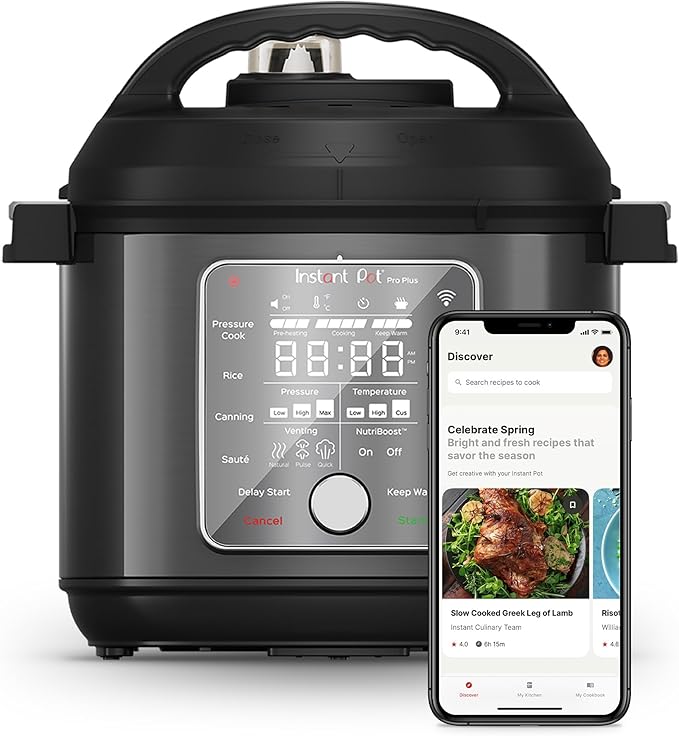
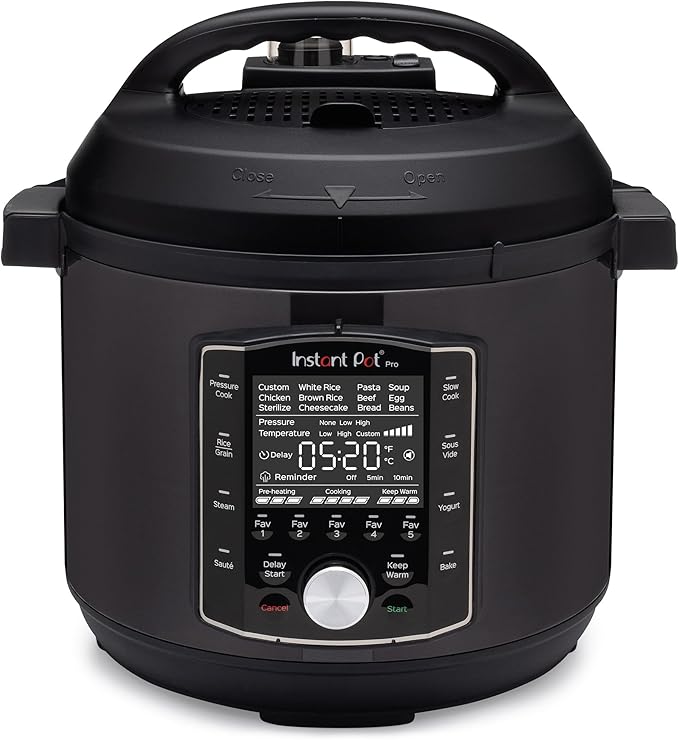
The Pro is Instant Brands' answer to a decade of feedback on the Duo line. It adds a quieter NoiseReduction steam diffuser, 28 fully customizable programs (versus preset-only on the Duo), a heavier tri-ply stainless inner pot, redesigned side handles for lifting the appliance, and a brighter LCD with a progress bar. Pressure cooking and sauteing perform the same as on the Duo line. The upgrades are ergonomics, noise, and customization. Everything in this review is about whether they justify the premium.
How the Instant Pot Pro differs from the Duo line
Mechanically the Pro is the same pressure cooker as the Duo: a sealed pot with a heating element in the base, a pressure sensor, and a steam-release valve on the lid. Cooking performance is identical. What changes is the layer of features on top. The Pro has 28 programs against 15 on the Duo Plus and 13 on the Duo, and every one of them is fully customizable, with time, temperature, pressure level, and keep-warm behavior saved per program. The Duo Plus customizes a little. The base Duo is preset-only.
The NoiseReduction steam diffuser is the second difference that counts. It's a small silicone cap on the steam-release valve that breaks the venting jet into a softer hiss. Owners measure roughly half the perceived loudness during quick-release, and the engineered claim lands in the same range. In an open kitchen or a small apartment, it's the upgrade you notice every day.
The hardware upgrades are smaller. The inner pot is a heavier tri-ply stainless that browns more evenly during saute and scorches less during long braises. The side handles are handles now, instead of finger slots, which matters when you're lifting a full 6-quart pot. The display is brighter and shows a progress bar instead of a bare timer. No one of these is worth $50. Together they're the rest of the price gap.
What the Pro does well
Noise reduction is the one thing the Pro does better than every other Instant Pot. Quick-release venting on the Duo is loud enough to startle a sleeping pet from across the apartment. On the Pro it's a softer continuous hiss, unpleasant rather than alarming. In open-plan kitchens, or apartments where someone is working in the next room, this is the upgrade owners notice first and wouldn't give back.
Custom program saving is the second win. Cooks who make the same five things on rotation, a particular yogurt, a particular rice, a 90-minute pork shoulder, can save those exact settings as named programs and one-button them from then on. The Duo Plus remembers the last setting per category; the Pro keeps dedicated named slots. If you've dialed in favorites, that's real quality-of-life.
Saute and browning beat the Duo line noticeably. The tri-ply inner pot heats more evenly and holds temperature when cold food hits it, which is the exact moment standard inner pots dump heat and start sticking. Owners cooking braises and stews report less fond loss and easier cleanup than on previous generations.
Build quality is a step up too. The lid mechanism seats more cleanly, the silicone gaskets come out easily for washing, and the side handles make lifting a full pot a one-hand job. Instant Brands has kept parts available, gaskets, sealing rings, replacement lids, for the Duo line going back nearly a decade, and that track record is why long-time owners trust the brand on the Pro.
The upgrades are subtler than the price
The most common complaint is that the upgrades are subtle. Anyone coming from a Duo expecting a transformed cooking experience ends up disappointed, because the food tastes the same, because the cooking is the same. The Pro is a better-built, quieter, more customizable version of the Duo, not a fundamentally different appliance. Buyers expecting more should temper expectations.
The 28-program count is more marketing than function. Most of those programs run the same pressure and temperature with different default times (Soup vs Stew vs Bone Broth vs Meat). Owners who cook seriously tend to hit Pressure Cook with a custom time and ignore the named programs entirely. Customization is the feature you're paying for. The program count is decoration.
The NoiseReduction diffuser is not silent. It cuts venting noise a lot without eliminating it, so quick-release is still a noticeable hiss, just no longer alarming. Anyone expecting whisper-quiet release will be let down. Natural release, waiting 10-30 minutes for pressure to drop on its own, is still the silent option on any model.
Then the price. At $170 the Pro is double the $90 base Duo, and for owners who run it as a one-button rice cooker or a weekly chili pot, that premium never pays back. Instant Brands drops the Pro to $130-150 a couple of times a year (Prime Day, Black Friday). Patient buyers should wait for a sale rather than pay full retail.
Who the Instant Pot Pro is for
Cooks who use the customization. Clearest yes in the review. If you have a yogurt recipe at 110F for 8 hours, a rice setting at low pressure for 4 minutes, and a braise at 50 minutes high pressure, and you want each one as a single button press, the Pro is the model that does it. The Duo Plus won't save those slots. The base Duo won't let you set them at all.
Owners in open-plan kitchens or apartments where venting noise matters. The NoiseReduction diffuser is the most-cited reason owners upgrade from a Duo to a Pro and say it was money well spent. If the kitchen shares a room with a living area, a nursery, or a home office, that upgrade pays back daily.
Long-time Duo owners replacing a worn-out unit. If you've used a Duo for five years and it's the appliance you reach for weekly, $50 more for quieter venting, a heavier pot, and customizable programs is a small premium on a tool you'll use for another five years. Buying the same Duo again is the safer-but-worse choice.
Who should skip the Pro
First-time multicooker buyers should start with the Duo Plus at $120 or the base Duo at $90. The Pro's upgrades are things you appreciate once you know what you want to customize, and they're invisible to a buyer who hasn't used a multicooker before. Buy a Duo, use it for a year, and move up to a Pro only if you've hit a real limit.
One-button cooks, rice, soup, pressure cook, walk away. Customization is what the extra $50 buys, and if you won't use it, the Duo Plus does the same pressure cooking with the same preset programs at a real discount. The base Duo does the same thing minus a handful of presets, at the deepest discount.
Cooks who want pressure cooking and air frying should look at the Ninja Foodi. The Instant Pot Pro doesn't air fry; Instant Brands sells a separate $50 air-fryer lid accessory that owners call workable but not great. The Ninja Foodi TenderCrisp does both well in one appliance, at the cost of more counter space and a heavier lid.
If the Pro isn't the right Instant Pot
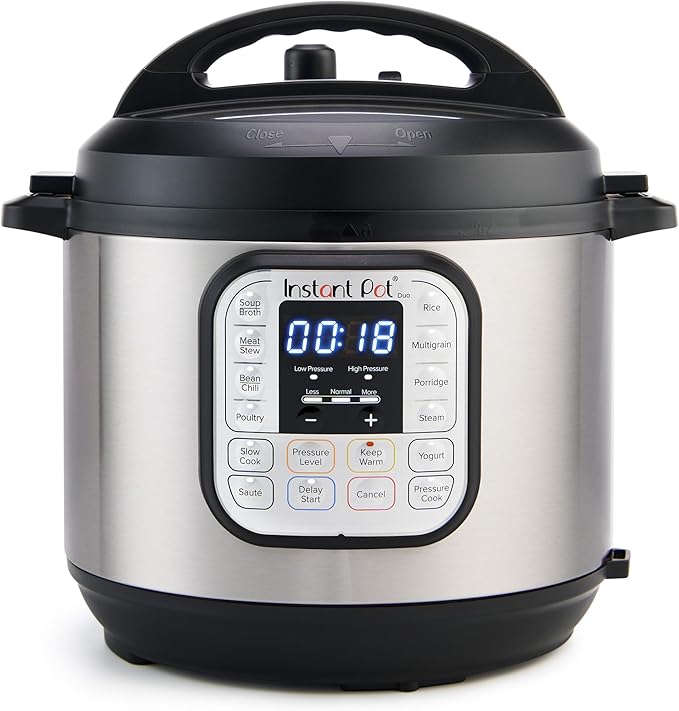
Instant Pot Duo Plus at roughly $120, the closest alternative and the recommended step-down. A 9-in-1 with 15 preset programs, a clean LCD, and the same pressure-cooking performance as the Pro. No NoiseReduction diffuser, no tri-ply inner pot, no custom program saving. If you don't need those three things, this is the honest pick and the $50 stays in your wallet.
Ninja Foodi TenderCrisp at roughly $200, for cooks who want air frying in the same appliance. It pressure cooks, slow cooks, and air-fries with a separate crisping lid. The trade is a heavier, larger appliance and a slightly less refined pressure-cooking experience than the Instant Pot Pro. If there's counter space for one multicooker rather than two, take the Foodi.
Instant Pot Duo at roughly $90, the budget answer. The original 7-in-1 has been in production since 2016 with minor revisions, and it's the appliance that built the Instant Pot category. Pressure cooking is identical to the Pro. What's missing is customization, the quieter diffuser, and the better inner pot. For one-button cooks the Duo is the honest recommendation and the Pro is overspend.
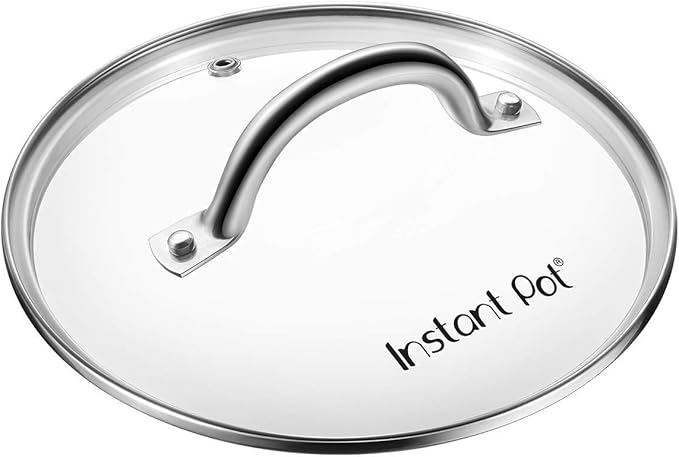
A tempered glass lid is the one accessory worth pairing with any Instant Pot. It turns the appliance into a usable slow cooker or saute pan without pressure, and the standard pressure lid is awkward for stirring and visibility. At roughly $15 it's the most useful $15 in the Instant Pot accessory aisle, and it fits the Pro, the Duo Plus, and the Duo.
The verdict on $170
The Instant Pot Pro is worth $170 if you customize programs, if venting noise matters in your kitchen, or if you're replacing a worn-out Duo and want the small but real upgrades. In those cases the premium over the Duo Plus is justified, and this is the appliance you'll use for the next five to seven years without wishing you'd paid more.
It isn't worth $170 if you're a first-time buyer, a one-button cook, or someone who wants air frying in the same appliance. Then the honest recommendation is the Duo Plus at $120, the base Duo at $90, or the Ninja Foodi at $200, depending on which trade-off matters most. The Pro is the right top-of-line pick. It's not the right default.
Our Ratings
Overall score
The Pro shares the Duo's pressure mechanism but steps up everything around it: a heavier tri-ply stainless inner pot, a lid-position sensor that won't start unless sealed, redesigned side handles that make lifting safer, and a NoiseReduction diffuser that runs measurably quieter. 28 fully customizable programs replace the Duo's presets. Build quality is the strongest argument for the Pro.
Brushed stainless with a flat black control panel reads more appliance, less plastic, than the glossier Duo, and the large LCD with progress bar is genuinely useful across the kitchen. At 13.4 inches tall and roughly 14 pounds it's counter-sized rather than stowable, so measure before ordering. One of the better-looking 6-quart multicookers, though the Ninja Foodi competes hard at the same price.
This is where the Pro gets harsh: the $90 Duo does roughly 80% of what it does, just louder and preset-only, and the $120 Duo Plus splits the difference. The Pro's $50 premium over the Duo Plus is justified only for people who pressure-cook three or more times a week, hate the release noise, or want custom programs. For occasional or first-time buyers, the $90 Duo is the smarter purchase.
Instant Pot Pro on Amazon.
Frequently asked questions
Is the Instant Pot Pro worth it?
The Instant Pot Pro is worth $170 if you use the customizable programs, if you cook in the kitchen often enough that the quieter NoiseReduction steam diffuser matters, or if you've already worn out a previous-generation Duo and want the upgrade. It isn't worth $170 if you mostly press one button (rice, soup, pressure cook) and walk away. In that case the $120 Duo Plus does the same job and the $90 base Duo does roughly 80% of the job for half the price.
How is the Instant Pot Pro built?
The Pro shares the Duo's pressure mechanism but steps up everything around it: a heavier tri-ply stainless inner pot, a lid-position sensor that won't start unless sealed, redesigned side handles that make lifting safer, and a NoiseReduction diffuser that runs measurably quieter. 28 fully customizable programs replace the Duo's presets. Build quality is the strongest argument for the Pro.
What styles does the Instant Pot Pro work with?
Brushed stainless with a flat black control panel reads more appliance, less plastic, than the glossier Duo, and the large LCD with progress bar is genuinely useful across the kitchen. At 13.4 inches tall and roughly 14 pounds it's counter-sized rather than stowable, so measure before ordering. One of the better-looking 6-quart multicookers, though the Ninja Foodi competes hard at the same price.
Options Worth Checking Out
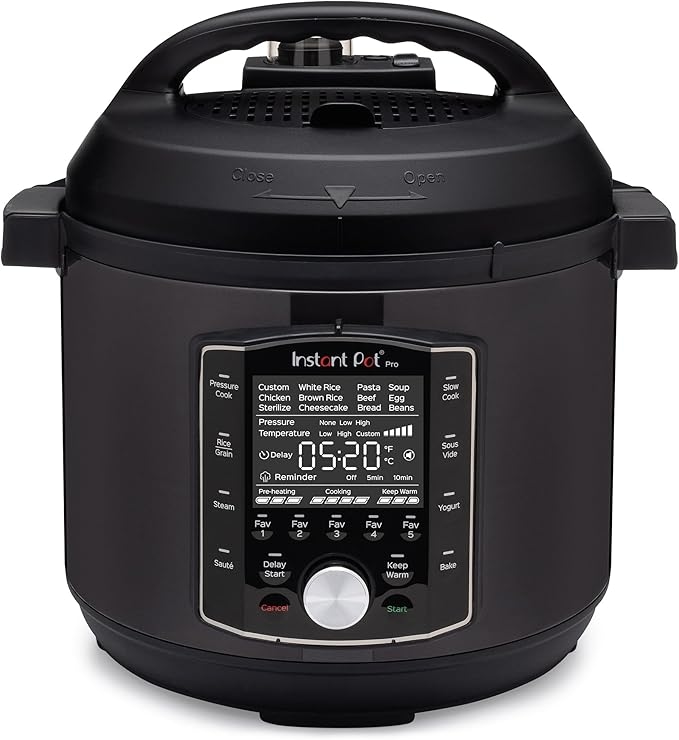
Instant Pot Duo Plus 6 Quart 9-in-1
The honest step-down at $120. Same pressure-cooking performance as the Pro with 15 preset programs and a clean LCD. Skips the NoiseReduction diffuser, the tri-ply pot, and custom program saving. Right pick if you do not need those three things.
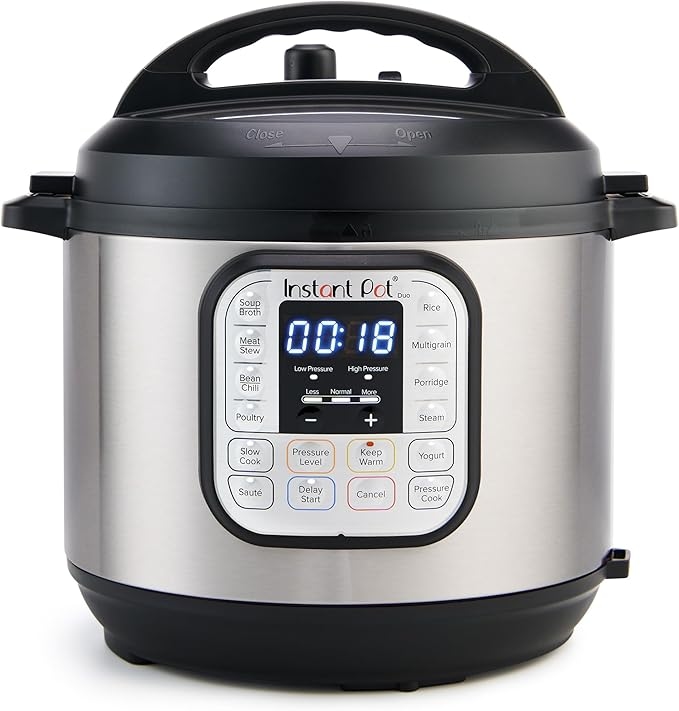
Instant Pot Duo 6 Quart 7-in-1
The budget answer at $90 retail (often $65 on sale). Original 7-in-1 with identical pressure-cooking to the Pro. No customization, no quieter diffuser, no upgraded pot. Honest pick for one-button cooks.
You Might Also Need
Accessories worth grabbing alongside your purchase