Floyd
Floyd Bed Frame Reviews + Our Take
By Daniel Reyes · Updated August 2026
Independent editorial review. We never accept payment for coverage, though we may earn a commission if you purchase through our links.
Verdict
Floyd has one of the larger and more candid owner communities in the platform bed category, driven by its Wirecutter endorsement and media coverage that pulled in a self-selecting pool of buyers who write about their purchases. The multi-year ownership reports are the most useful signal: owners who have lived with the bed through two to four moves and three to five years report consistent structural integrity, strap tension that has not loosened, and visual condition that has 'barely noticed wear.' Assembly complaints cluster among first-time assemblers who followed the booklet instructions rather than the online video, a gap in the out-of-box experience Floyd has not resolved through better packaging. Floor sliding is the functional complaint raised most often in online communities, and it's the one most clearly solved by a rug. Headboard creak complaints come from owners who lean heavily against it while reading or watching something. Shipping delays have been documented in recent years (2023-2024), with orders sitting for weeks without an update and at least one case of missing items 21 weeks after ordering. That reads as a logistics pattern rather than a product quality pattern, but budget extra lead time if you're planning a room around a Floyd delivery.
Read full take ↓Similar beds

The modular platform bed for renters who want real furniture
The Floyd Bed Frame is the most Wirecutter-endorsed, Instagram-photographed, renter-approved platform bed on the market, and it has largely earned that reputation. It's designed in Detroit, made from FSC-certified birch veneer panels and powder-coated steel, and assembled with nothing more than a ratchet strap. Ten years of editorial recommendations have piled up behind it, along with a community of owners who have carried it through two, three, and four apartments without touching a tool.
Floyd launched in 2014 with a specific design brief: furniture for people whose lives require furniture that can move with them. The tool-free modular system, panels that slot together and tension under a ratchet strap, is the engineering answer to that brief, and it holds up in practice. Multiple owners report reassembling the frame across moves over three to five years with no meaningful degradation in strap tension. The core promise gets delivered.
The market gap Floyd sits in is real and underserved, between IKEA platform beds that feel temporary and Thuma or Room and Board beds that feel permanent. If you're in the transitional phase, wanting real furniture before your address has settled, the Floyd is the strongest option at its price. If you've settled and you care more about stability, silence, and material refinement than portability, Thuma edges it for roughly the same money. What follows is what you give up to get the Floyd, and whether that's a fair trade in your situation.
What the materials are
The construction is two material systems working together: birch veneer panels over a honeycomb engineered core, and powder-coated steel supports under a ratchet strap tensioning system. The birch panels are CARB 2 compliant, the most stringent formaldehyde emissions standard for composite panels in the US market, and the honeycomb core keeps them light without giving up structural integrity. In bedroom furniture that certification carries weight, since off-gassing from lower-grade composite panels is a documented health concern.
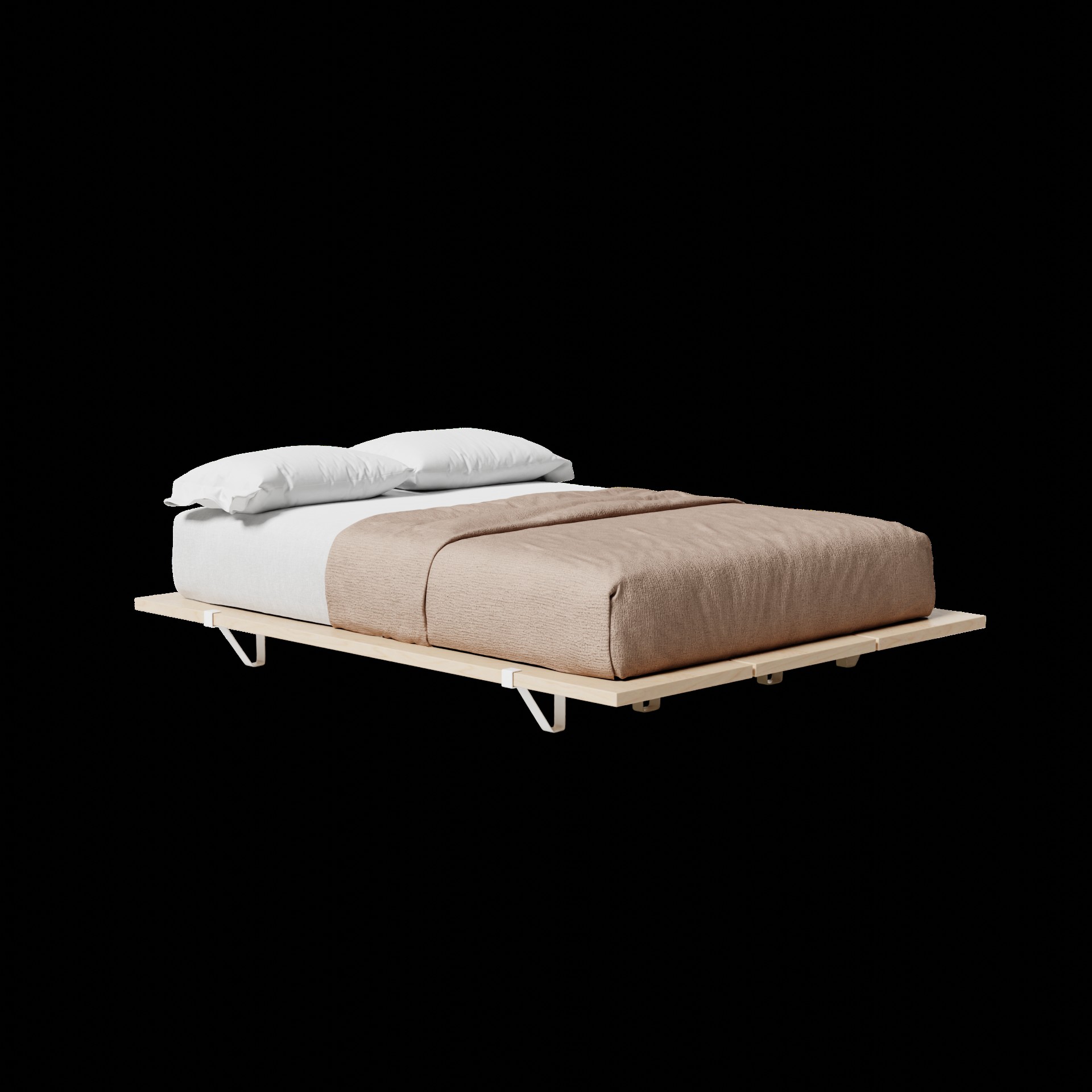
The steel supports come from a single piece of steel bent eight times. That wastes less material and produces a more structurally consistent component than a welded assembly, and it removes the weld heat-affected zones where fatigue cracks usually start in metal furniture. The supports slot into channels machined into the panel edges, and ratchet straps running underneath the assembled frame pull everything tight. Tension alone holds the frame rigid, with no mechanical fasteners, which is the trick that makes the Floyd both portable and strong.
The veneer comes three ways: standard birch (the most photographed), sustainably sourced walnut veneer (darker and warmer), and US-sourced white oak veneer (the most premium finish). All three are clean, contemporary, and photograph well against white walls. The finish is matte rather than glossy, which keeps it clear of the furniture-showroom feeling that glossy laminates give off.
The trade-offs nobody mentions
Start with hardwood floors. The Floyd Bed Frame has a well-documented and unresolved sliding problem: without a rug underneath, the steel leg ends don't grip hardwood or tile. Cork sticker feet are included, and they peel off the first time you reposition the bed. Floyd acknowledges this in its FAQ, and the fix is a bedroom rug. If you already have one, this is a non-issue. If you prefer bare floors, it's a genuine limitation Floyd hasn't engineered away in ten years of production.
The mattress platform is a solid panel surface, not slatted, so it suits every mattress type including memory foam that requires a solid base. Smooth-bottomed memory foam does slide on the uncoated birch. Floyd's documented fix is a rug pad between the mattress and the frame. Not a structural problem, but it's an extra purchase that's easy to miss in the marketing.
Panel drift gets discussed less and deserves naming. Panels can drift perpendicular to the supports over time under load cycling and shifting body weight, and they need periodic manual realignment. That's a ten-second task, not a structural failure, but it isn't mentioned in Floyd marketing and it surprises owners who run into it. It also isn't a sign of degradation. It's how a tension-maintained assembly behaves rather than a fastener-maintained one, and structural integrity is unaffected. Knowing it's normal is the difference between a reassuring ten-second correction and an anxious Amazon review.
The headboard needs its own caveat. It mounts to the frame with a slotted clip system, and it creaks under the pressure of reading in bed or sitting back against it. At least one owner report describes the headboard shifting out of the frame gaps after the clips loosened over time. It's also the component most often described as less refined than the base frame, a quality gap inside a single product that you can't unsee once you've noticed it. The base frame is the product strength. The headboard is optional and the weakest part of the package.
Style and sizing
The Floyd aesthetic is Bauhaus-adjacent: honest materials, visible structure, no ornament that isn't also function. Birch veneer panels and powder-coated steel read contemporary-industrial without the heaviness of an actual steel bed. It works in Scandinavian-influenced bedrooms, in modern minimal rooms, and in transitional spaces that haven't committed to a direction yet, partly because the material palette is neutral and partly because the bed has turned up in so much aspirational interior photography.
Available in Twin, Full, Queen, and King. The modular expansion kit converts between Full/Queen and King configurations by adding or removing panels, an unusual feature and a directly useful one if you expect a bedroom size change. Under-bed clearance is 6 inches, enough for most standard storage bins and not enough for suitcases, which typically need 7-8 inches. Weight capacity runs 550 lbs for Twin, 750 lbs for Full/Queen, and 850 lbs for King, above-average specifications for the platform bed category.
The low-profile platform height, approximately 7.5 inches, keeps the bed grounded and visually horizontal. That reads contemporary under high ceilings and feels compressed under lower ones or beside existing high-furniture pieces. If you need a higher bed, for ease of getting in and out or to pair with a specific mattress loft, note that the platform height is not adjustable.
The honest math on value
Pricing by size: Full/Queen starts at $796, King at $995, with the headboard adding approximately $274. Floyd's most direct comparable is Thuma at approximately $899 queen. Floyd's advantages: explicit modularity through the expansion kit, a lower entry price, and a brand community built around the specific use case of moving apartments. Thuma's advantages: cork-padded legs that grip hardwood floors without a rug, Japanese joinery that eliminates creaking, and a slightly more premium material feel in the headboard and side panel connections.
The 10-year warranty covers defects in material and workmanship and runs above industry standard for the platform bed category. Warranty claims appear infrequently in owner communities, which is consistent with the durability reports from multi-year owners who have reassembled the frame through several moves. Claims go by email with a five-business-day response window, not the fastest in the category, though the coverage term is strong.
Shipping is the soft spot. Delays have been documented in recent years (2023-2024): orders with no shipping updates for multiple weeks, and at least one report of missing items 21 weeks after ordering. That looks like a logistics pattern rather than a product quality pattern, but budget extra lead time if you're planning a room around a Floyd delivery. On a tight timeline, contact Floyd directly for current lead time estimates before ordering.
Who should buy this
Renters in the transitional phase of life who want genuine furniture that can move with them, are willing to use a bedroom rug (most people are), and value portability and design over absolute stability and silence. It's especially strong if you expect to convert between Full/Queen and King as your housing changes, since the expansion kit does that for a fraction of the cost of a new frame.
The wrong buyer sleeps on bare hardwood without a rug, leans heavily on the headboard, needs suitcase clearance for under-bed storage, or wants total silence from a frame connection system. That profile should look at Thuma, the best tool-free alternative for hard floors, or at traditional bolt-together platform frames from West Elm or Room and Board if they've settled down and want refinement over portability.
Assembly is genuinely tool-free and straightforward for two people who watch the online video rather than relying on the booklet. White-glove delivery at $299 is available but not required. First-time assembler complaints are concentrated among buyers who followed the booklet instructions, and the video resolves almost all of them. Once you understand it, the assembly experience is the product doing exactly what it promises: a bed that goes together without tools and comes apart just as easily.
Floyd The Bed Frame: construction deep-dive
Frame and slats
The structure is built from two material systems that work together: birch veneer panels over a honeycomb engineered core, and powder-coated steel supports with a ratchet strap tensioning system. The supports are the engineering centerpiece. Each one is formed from a single piece of steel bent eight times, which wastes less material and produces a more structurally consistent component than a welded assembly. They slot into channels in the panel edges and are tensioned by ratchet straps that run underneath the assembled frame, so the rigidity comes from tension rather than mechanical fasteners. The mattress platform is a solid panel surface (not slatted), which suits every mattress type including memory foam mattresses that require a solid base.
Headboard
The Floyd headboard is a separate add-on, not included with the base frame, and runs about $274. It mounts to the frame with a clip-and-hardware system rather than the ratchet-strap tension that holds the base together. Owner reports flag it as the weakest part of the package: it can creak under the pressure of leaning back, and the clips can loosen over time. Available in standard birch, sustainably sourced walnut veneer, and US-sourced white oak veneer, each showing the natural grain character of its species.
Upholstery
None. This is a hard-surface design with no upholstered components, and the birch veneer panels carry the warmth instead of fabric. The panel surfaces are finished to protect against normal wear, though Floyd's warranty excludes surface finish aging, moisture and sunlight damage, and modifications. No upholstery also means no fabric wear and none of the cleaning considerations that come with upholstered bed frames.
Dimensions and weight
Weight capacity is 550 lbs for the Twin, 750 lbs for Full and Queen, and 850 lbs for the King, above average for the platform bed category and worth knowing if you have a heavier mattress or a couple whose combined weight runs past the industry average tested capacity. Under-bed clearance of 6 inches clears most under-bed storage bins but not suitcases, which typically require 7 to 8 inches. If under-bed storage is a primary use case, verify your bin dimensions before purchasing.
Assembly
No tools. The ratchet strap tensioning system and channel connections need no fasteners or hardware installation, and two people can put it together in roughly 10 to 15 minutes. One maintenance consideration: panels can drift perpendicular to the supports over time and need periodic manual realignment. Ten seconds of work, not a structural failure, but it isn't mentioned in Floyd's marketing and it surprises some owners. The frame disassembles just as quickly, which is the practical payoff for renters who move frequently.
Warranty
The 10-year warranty on the bed frame covers defects in material and workmanship for the continental US. It excludes surface finish aging, normal wear and tear, moisture and sunlight damage, and modifications. Claims go through email with a five-business-day response window. Frame warranty claims appear infrequently in owner reports, which is consistent with the structural durability data from multi-year owners.
Our Ratings
Overall score
Modular, lightweight, and built to survive repeated moves rather than to be an heirloom. The birch veneer and honeycomb-core panels aren't solid timber and don't pretend to be, while the single-piece bent-steel supports with ratchet tensioning have held across documented three-to-five-year ownership without loosening. The headboard is the weak point: the clip mount is adequate but creaks and can loosen, which anyone who leans hard will notice.
Scandinavian minimalism with restraint: a low profile, clean panel edges, and steel details that read architectural rather than industrial. The natural birch works across warm and cool palettes, with walnut and white oak options plus white or black hardware to widen the range. The flat clip-held headboard looks clean but says less than the base frame, and its plainness shows more in person than in photos.
At $796 to $995 for the base frame, the Floyd sits between IKEA platform beds and premium options, with its real edge being genuine modularity and a durability record across multiple moves. Against Thuma, its closest rival, Floyd wins on expandability and a lower entry price, while Thuma edges it on quiet, finished-feeling stability if you stay put. Assembly is genuinely tool-free, so the $299 white-glove upgrade isn't required.
Frequently asked questions
Is the Floyd Bed Frame worth it?
At $796 to $995 for the base frame, the Floyd sits between IKEA platform beds and premium options, with its real edge being genuine modularity and a durability record across multiple moves. Against Thuma, its closest rival, Floyd wins on expandability and a lower entry price, while Thuma edges it on quiet, finished-feeling stability if you stay put. Assembly is genuinely tool-free, so the $299 white-glove upgrade isn't required.
How is the Floyd Bed Frame built?
Modular, lightweight, and built to survive repeated moves rather than to be an heirloom. The birch veneer and honeycomb-core panels aren't solid timber and don't pretend to be, while the single-piece bent-steel supports with ratchet tensioning have held across documented three-to-five-year ownership without loosening. The headboard is the weak point: the clip mount is adequate but creaks and can loosen, which anyone who leans hard will notice.
What styles does the Floyd Bed Frame work with?
Scandinavian minimalism with restraint: a low profile, clean panel edges, and steel details that read architectural rather than industrial. The natural birch works across warm and cool palettes, with walnut and white oak options plus white or black hardware to widen the range. The flat clip-held headboard looks clean but says less than the base frame, and its plainness shows more in person than in photos.