Crate & Barrel
Crate & Barrel Petrie Sofa Reviews + Our Take
By Daniel Reyes · Updated September 2026
Independent editorial review. We never accept payment for coverage, though we may earn a commission if you purchase through our links.
Verdict
Petrie owners consistently cite long-term shape retention as the piece's standout quality. Multiple owners who previously owned West Elm Harmony sofas note the Petrie holds up better over time despite similar pricing.
Read full take ↓Similar sofas
Quick Take
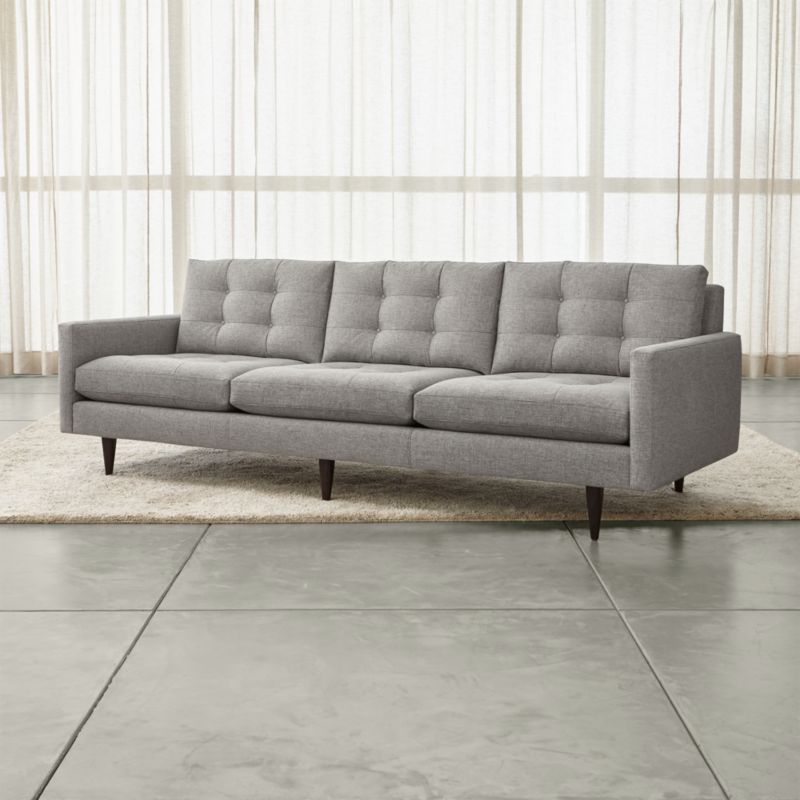
A modest premium over West Elm that buys meaningfully better construction consistency. A benchmade kiln-dried hardwood frame on sinuous springs, soy-based polyfoam seat, and hand topstitching and button tufting. A fair trade if you keep sofas seven years or more and want a design that ages rather than dates.
The mid-century sofa Crate & Barrel gets right
The Petrie Sofa has been in Crate & Barrel's lineup for years and keeps selling because it keeps earning it. The mid-century-inspired market is crowded with sofas that look the part on screen and disappoint in person. The Petrie delivers on the photo and then does better than you'd expect under the seat cushions, where nobody looks.
That's not a small thing. Mass-market retailers have strip-mined the mid-century aesthetic so thoroughly that the label means close to nothing now. You can buy a "mid-century sofa" at Target for $400 or from a boutique furniture maker for $8,000. The Petrie sits at $2,099-$3,100+ and belongs in a different tier than the flood of look-alikes at its price point, not because the leg profile is slightly tapered (it is) but because the cushion build and benchmade frame underneath are meaningfully better.
Why the cushion build matters at this price
Most sofas in the $1,500-$3,500 range ride on sinuous wire springs, the S-shaped springs that run front to back across the seat frame. They're competent, inexpensive to manufacture, and entirely adequate, and they're what West Elm puts in the Harmony, what Article puts in most of its lineup, and what turns up in the majority of mid-market sofas. The Petrie uses the same sinuous wire suspension, so the spring system isn't where it pulls ahead.
What sets it apart sits on top of those springs. The seat cushions are soy-based polyfoam wrapped in fiber and encased in downproof ticking, and the whole seat is topstitched and button-tufted by hand. The tufting isn't only decorative; it anchors the fill so the cushion holds its shape instead of drifting into the dips a loose, untufted seat develops. On a sofa you plan to own for eight to twelve years, that fitted construction is one of the places where the quality difference shows up over time.
Crate & Barrel doesn't hide any of this, though they don't shout about it either. Understand it before you comparison-shop the Petrie against the West Elm Harmony at similar price points. On screen the two look extremely similar. The build details, the tufted, fitted cushions and the benchmade kiln-dried frame, are where they separate.
Mid-century design, done with restraint
The Petrie's profile is clean without being cold. Tapered hardwood legs in a dark ebony stain anchor the silhouette and read as real furniture rather than the painted-wood-pretending-to-be-hardwood you get from lesser pieces. The track arm is low and squared. The seat depth is generous without going to the aggressive platform-sofa depth that makes sitting upright awkward. The back cushions have enough structure to hold their shape without the stiff, formal quality that turns a sofa into hotel-lobby furniture.
It photographs well in virtually every setting, which is no accident. It also works in a real room with real light and real use, which not every photogenic sofa manages. The proportions are balanced enough that it neither dominates a space nor needs a large room to breathe.
Who this sofa is for
The Petrie's buyer wants a sofa that reads as designed, holds up well, and doesn't force them to justify a price in the $5,000-$10,000 range to themselves every time they sit down. It slots into rooms that mix mid-century furniture with contemporary accessories, warm wood tones, or something more minimal. You don't need a specific design vocabulary to make it work.
It's the wrong sofa if you want an extremely plush, sink-into-it seat. Cushion firmness sits on the medium side, supportive enough for people who read or work on the sofa, soft enough for evening lounging, and short of the cloud-seating experience deep, down-filled sofas provide. If maximum softness is your primary criterion, look elsewhere.
Petrie vs. the alternatives
The West Elm Harmony is the most direct visual competitor. Both are mid-century adjacent, both price between roughly $1,600 and $3,200, and both turn up on the same mood boards. Both ride on sinuous wire springs, so the suspension is a wash; the Petrie's edge is in its tufted, fitted cushions. Multiple long-term owners document the Harmony's back cushions going noticeably flat by year two. The Petrie's cushion fill and construction are less prone to that pattern. Owners who've used both and switched from the Harmony to the Petrie report higher long-term satisfaction, consistently.
The Joybird Hughes is the other common comparison. The Hughes uses hand-tied spring construction (a genuine quality indicator), sits at a lower price point, and feels warmer and a bit more casual. If you prefer hand-tied construction and want to spend less, the Hughes is a legitimate alternative. The Petrie's tufted, soy-based polyfoam cushions chase the same goal, long-term seat support, by a different route, and both approaches have merit.
The Lounge II (also available in hand-tied construction at a price near the Petrie's) rounds out the competitive set. The Lounge II is more formal in character and slightly firmer. The Petrie has a lighter, more casual energy that works in a broader range of rooms.
Price context and honest trade-offs
At $2,099 in the base two-seat configuration, the Petrie is priced reasonably for benchmade, button-tufted construction and solid hardwood legs. The number climbs fast with sectional configurations, premium fabrics, and the extra-deep seat option; $3,100+ for a three-seat in a premium fabric is nothing unusual. Crate & Barrel runs sales periodically that bring these numbers down, and they have a price adjustment policy worth knowing about.
The trade-off, plainly: you're not getting eight-way hand-tied construction at this price, and the fabric list, extensive as it is, doesn't match the breadth of performance-grade textiles some competitors offer. The 1-year warranty is industry-standard and nothing better than that for a piece at this price. Crate & Barrel's delivery and white-glove assembly service is reliable and well-reviewed, which matters when a sofa has to get up apartment stairs.
What owners report after 3-5 years
The clearest read on the Petrie's durability comes from owners who have lived with it for multiple years rather than unboxed it last month. The long-term pattern is consistent: the tufted seat cushions keep their feel across years of regular use, without the progressive softening that loose, untufted seats commonly develop. Back cushions need occasional redistribution but hold their volume better than down-blend alternatives. Leg attachment stays firm, with no loosening documented in owner reports.
Fabric is where the Petrie shows its price tier after several years. Standard linen and non-performance wovens pill and fade on high-contact areas, the seat cushion tops and the inner arm, faster than performance fabrics do. Buyers who selected performance fabrics at purchase report significantly better fabric condition at the five-year mark. Planning to own this sofa for a decade? The performance fabric upcharge at purchase is money well spent.
The Petrie in a real room
One thing the Petrie gets right that many mid-century sofas don't is the trip from photograph to physical space. Plenty of well-designed furniture looks better in a staged shoot than in a real apartment with real proportions, real light, and real clutter nearby. The Petrie's proportions, seat height, back height, arm depth, are calibrated well enough to work across a range of room scales. It doesn't feel oversized in a small apartment living room, and it doesn't get lost in a larger space.
The dark ebony stain reads warm against wood floors and grounds the frame without matching the flooring too closely. Crate & Barrel lists eleven leg options for the Petrie, so if the standard dark finish feels off for a room with lighter flooring or mixed wood tones, there's room to choose a leg that suits the space.
Frame, suspension, and cushion system
The Petrie's frame is kiln-dried hardwood, the standard specification for quality upholstered furniture, meaning the wood's moisture content has been controlled to reduce warping and joint failure over time. The joints are reinforced at high-stress points, and the frame construction is what you'd expect from a sofa in this price tier.
Sinuous wire suspension
The seat rides on a sinuous wire spring suspension, the S-shaped springs that run front to back and are benchmade into the kiln-dried hardwood frame. It's the same category of suspension most sofas in this price range use, and Crate & Barrel's own product page confirms it. Tensioned correctly, it holds its shape and resists sagging well under normal residential use. Where the Petrie earns its keep is one level up, in the cushions that sit on those springs.
The practical result: after five or more years of regular use, the tufted, fiber-wrapped seat cushions keep more of their original profile than the loose, untufted cushions on many sofas at this price. Owners who have compared the two report the difference consistently.
Seat and back cushions
Seat cushions use a soy-based polyfoam core wrapped in fiber and encased in downproof ticking. The plant-based polyfoam rebounds well after compression, and the fiber wrap plus downproof ticking give the seat its surface softness while holding the fill in place. The medium firmness feel is consistent across the range.
Back cushions
Back cushions are filled with a blend of virgin and recycled fiber encased in downproof ticking, for a softer, more relaxed quality. They ask for some maintenance, periodic redistribution after heavy use keeps them looking even, but the construction outlasts feather-forward blends that compress quickly. No daily fluffing regimen required.
Fabric options
The Petrie comes in a substantial range of upholstery options including performance velvet, performance linen, standard linen, boucle, and leather. With pets or children in the house, the performance textiles, higher rub counts and easier stain resistance, are the practical choice. Long-term owners rate the velvet and linen in performance grades well for durability without giving up visual quality.
Legs, delivery, and warranty
The standard tapered leg is solid hardwood finished in a dark ebony stain, not painted composite, and Crate & Barrel lists eleven leg options in all. The leg-to-frame attachment is solid, and no wobble issues turn up in long-term owner reports.
Crate & Barrel offers standard delivery with white-glove assembly as an add-on, and reviews consistently praise the delivery service. The warranty is 1 year on fabric and workmanship, standard for the industry, though shorter than what some premium competitors offer. Frame and suspension are covered; fabric wear beyond normal use is not.
Our Ratings
Overall score
A benchmade kiln-dried hardwood frame on sinuous wire springs, with a soy-based polyfoam seat and virgin-and-recycled-fiber back cushions, all in downproof ticking. Topstitched and button-tufted by hand and made in the USA of domestic and imported materials. The tufted, fitted construction resists the sag that loose-back designs develop over time.
The Petrie's clean track arm, tufted seat, and precise proportions are among the most photographed mid-priced sofas for good reason. The design feels more considered than most catalog sofas at this price and holds up stylistically across room changes.
At $2,099-$3,100+, the Petrie charges a modest premium over West Elm for meaningfully better construction consistency and a design that ages better. A fair trade for buyers who keep sofas for 7+ years.
What People Are Saying
Petrie owners consistently cite long-term shape retention as the piece's standout quality. Multiple owners who previously owned West Elm Harmony sofas note the Petrie holds up better over time despite similar pricing.
Reddit and Houzz commentary are weighted 3× against blog and editorial sources in our sentiment score. Brand PR has a well-documented influence on editorial coverage — direct owner reports from message boards tend to be more candid.
What Reddit Is Saying
“I have an 8 yr old Petrie, with a german shepherd. It is toast now, but still in remarkably good shape for this long! It's been through many moves, and the seat cushions started to give up about a year ago. Much longer than the typical life of couches - and absolutely worth the money, IMHO.”View thread →
“this was a very common and expected thing with brand new sofas, no matter the piece, because they need to be 'broken-in'. The amount of time it takes to break them in fully depends on how much you use the sofa - naturally, the more you use it, the quicker it will 'soften'.”View thread →
“Although frame of couch is super well made, the fabric is not as durable. The fabric is completely torn by now. No replacement cushion available, my option is to buy a new couch or find third party to reupholster which cost close to a new couch.”View thread →
“We are of our second Petrie Sofa. Our original one is going on 12 years old and is super comfortable. It's the smaller 86" version, so when we moved it to our garage apartment we upgraded to this 100" version. I was so excited to get this sofa, but damn why is it so firm? Like uncomfortably firm. Can anyone else with this sofa confirm it's like sitting on a hard bench? I feel like I need to take half the stuffing out of the pillows—that's how bad it is.”View thread →
“I have this sofa and while I love the look, I find it crazy uncomfortable to sit on more than briefly. It's now our "fancy living room" couch and not a cozy one. My mom has a very similar one from Room & Board and it's infinitely more comfortable.”View thread →
What Others Are Saying
“ys of receipt. What we think: Although the Petrie Midcentury is more of an upright sofa than one for lounging, the midcentury modern style is a sure-winner. I mean, look at how sleek it is. Once you place this in your home, it changes everything. Say hello to classy! 3. Crate & Barrel Willow II Slipcovered Sofa Image credit: Crate & Barrel Price: (2023) $1,949 - $2,499 What's good What's not so good Easy to clean Machine-washable sofa cover”Source →
“This sofa isn't a soft fluffy sink into kind of couch; however, it does provide plenty of support and I was completely comfortable logging several hours on it while working on my laptop.”Source →
“the Petrie sofa really doesn't age well.”Source →
“I had a really difficult time with the buttons. They kept popping off.”Source →
Frequently asked questions
Is the Crate & Barrel Petrie Sofa worth it?
A modest premium over West Elm that buys meaningfully better construction consistency. A benchmade kiln-dried hardwood frame on sinuous springs, soy-based polyfoam seat, and hand topstitching and button tufting. A fair trade if you keep sofas seven years or more and want a design that ages rather than dates.
How is the Crate & Barrel Petrie Sofa built?
A benchmade kiln-dried hardwood frame on sinuous wire springs, with a soy-based polyfoam seat and virgin-and-recycled-fiber back cushions, all in downproof ticking. Topstitched and button-tufted by hand and made in the USA of domestic and imported materials. The tufted, fitted construction resists the sag that loose-back designs develop over time.
What styles does the Crate & Barrel Petrie Sofa work with?
The Petrie's clean track arm, tufted seat, and precise proportions are among the most photographed mid-priced sofas for good reason. The design feels more considered than most catalog sofas at this price and holds up stylistically across room changes.
What do real owners say about the Crate & Barrel Petrie Sofa?
Petrie owners consistently cite long-term shape retention as the piece's standout quality. Multiple owners who previously owned West Elm Harmony sofas note the Petrie holds up better over time despite similar pricing.
Options Worth Checking Out
You Might Also Need
Accessories worth grabbing alongside your purchase