CB2
CB2 Decker Sofa Reviews + Honest Verdict
By Maya Chen · Updated August 2026
Independent editorial review. We never accept payment for coverage, though we may earn a commission if you purchase through our links.
Verdict
Reddit discussion of the Decker is almost entirely about how it looks, buyers asking for alternatives to the design rather than reporting on durability. The absence of durability complaints is a mild positive signal, though it also reflects lower ownership volume than PB or C&B. Broader CB2 sofa sentiment in owner communities skews toward style satisfaction with moderate comfort feedback: the firm cushions come up often, usually as a preference qualifier rather than a flaw.
Read full take ↓
City-scale modern, done honestly
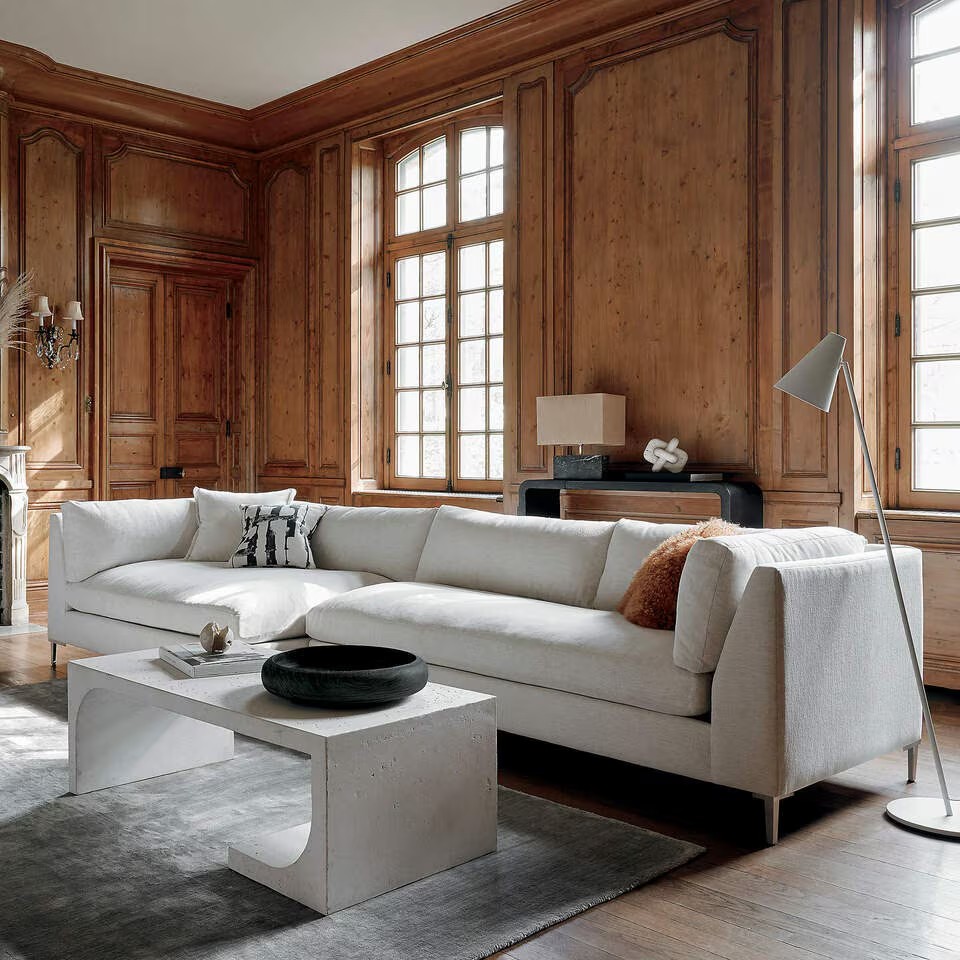
CB2 sells contemporary furniture with a genuine design sensibility, scaled for the way younger urban buyers live, and the Decker is one of the cleaner expressions of that promise in the catalog. It reads as designed rather than merely assembled. The wedge profile, the elongated back cushions, the brushed aluminum legs: somebody chose those. At 72 inches wide and 39 inches deep it's a true apartment-scale piece, and it fits rooms where a standard 86-inch sofa would dominate or crowd everything around it.
Its position in the market is a little odd. It goes up against West Elm, Pottery Barn, and Crate and Barrel, brands with deeper retail footprints and broader name recognition among furniture buyers. CB2's edge has always been design specificity, a willingness to commit to a visual direction that its more commercially cautious siblings hedge on. The Decker commits. The tweedy salt and pepper weave on the standard configuration, the oblong back cushion format, the low-to-the-ground silhouette, you can spot it as CB2 across a room without the brand's name anywhere on it.
Who it suits, and who it doesn't
The Decker works best in smaller apartments and urban living situations where scale discipline matters. At 72 inches it doesn't overwhelm a room. The 39-inch depth is comfortable without the pillow scaffolding a 46-inch deep sofa demands before a shorter person can sit upright. The Decker earns its place if you want a primary seating piece with a visible point of view rather than one that recedes into the background, with a cushion that starts supportive and relaxes into a softer, more enveloping feel the longer you own it.
Skip it if bottomless, deep-seat lounging is the priority. The multilayer soy-based polyfoam cushion system is wrapped in a down and feather blend, so it starts supportive and relaxes into a softer feel over time rather than staying board-firm. On a seat this scale it settles into a balance of slouch and support rather than the sink-all-the-way-in depth of a true cloud sofa. If sprawling movie nights are your main use case, spend the same money on a deeper-seated design. If you want a sofa that looks genuinely designed and still works as the main seat in the room, this one earns a real recommendation.
Construction fundamentals
CB2 lists the Decker's frame as benchmade with certified sustainable hardwood, kiln-dried to prevent warping. That's a credible specification at this price tier. Kiln-dried hardwood is the standard you want in a sofa frame, and benchmade means individual hand-assembly rather than full factory automation. The sinuous wire spring suspension is the standard approach in this category. It isn't 8-way hand-tied, which would cost considerably more, but sinuous springs hold up fine when properly tensioned and maintained. The multilayer soy-based polyfoam cushion system is the usual foam specification at this price, and it lasts when the foam density is adequate.
The brushed aluminum tapered legs deserve credit. At a price point where cheap plastic or hollow metal legs are common, the aluminum finish holds its look and shrugs off the warping and cracking that wood legs suffer in variable humidity. For renters who move frequently, a core CB2 customer, that matters more than it would for a homeowner staying put.
Value and competitive context
At roughly $1,399 to $1,699 for the standard sofa configuration, depending on fabric and current pricing, the Decker sits at the higher end of what most buyers consider mid-range. It costs more than comparable-sized pieces from Article or IKEA, and it lands squarely against the Pottery Barn PB Basic and West Elm sofas in the $1,200 to $1,800 window. What it offers that most competitors in that range don't is a more resolved aesthetic, a sofa that looks like a finished design product rather than a configurable box. The tradeoff is less customization. Fabric options are tighter and the dimensions are fixed rather than modular.
CB2 also doesn't match some competitors on warranty depth. The brand's standard warranty is limited, and post-purchase customer service has drawn mixed feedback in owner communities, particularly around cushion replacement and parts availability. If long-term support factors into your furniture decisions, weigh that against the design appeal. If you treat a $1,500 sofa as a five-to-seven-year purchase and plan to replace it when it wears out, the Decker makes sense on its own terms.
The apartment case
The strongest argument for the Decker is what it does at scale. Most sofas built for larger living rooms look awkward and overscaled in a 400-square-foot apartment living room. This one doesn't. The profile is low enough that it doesn't eat vertical space, and its 72-inch width seats two adults without dominating a smaller floor plan. For the buyer furnishing a first apartment or a downtown condo who wants something that belongs there rather than something squeezed in from a suburban showroom, the Decker solves a real problem. It's a sofa for people who have a design opinion and will pay a modest premium to act on it. It isn't a sofa for everyone, and it shouldn't try to be.
CB2 Decker Sofa: Construction Deep-Dive
Frame
Benchmade frame in certified sustainable kiln-dried hardwood. Kiln-drying pulls the moisture out before the frame goes together, so the seasonal expansion and contraction that eventually cracks joinery has less to work with. Benchmade means the frames are assembled by hand in individual units rather than moving down a full production line, which allows better quality control at the joint level.
Suspension system
Sinuous wire (S-spring) suspension, the standard approach in furniture at this price range. The springs run in parallel rows from the front rail to the back rail and give the cushions a consistent support surface. They're simpler than 8-way hand-tied coil springs, and reliable and durable as long as they're tensioned correctly and nobody overloads them.
Cushion fill and profile
Seat cushions are multilayer soy-based polyfoam wrapped in a down and feather blend: a structured foam core that holds its shape long-term, a softer and more enveloping top surface. The down/feather wrap means the cushions will relax and slouch over time. That's how the Decker was built, not a defect, but if you want a consistently crisp cushion silhouette, know it before you buy.
Upholstery
The standard Decker configuration comes in a 92% polyester, 8% linen blend, a snow white performance fabric treated for water and stain resistance. On a light-colored upholstery that treatment is doing real work, since the alternative is a fabric that's difficult to maintain. The polyester carries the durability and cleanability; the linen adds natural texture and visual warmth.
Legs and hardware
Tapered brushed aluminum legs, one of the details that sets the Decker apart from its neighbors on the sales floor. Aluminum outlasts the painted wood or hollow metal alternatives common in this price range, resists moisture, and won't chip or crack under load. The brushed finish ages evenly, developing a consistent patina instead of showing wear marks.
Dimensions
Note: The following dimensions reflect the international/metric variant of the Decker sectional. US market dimensions may differ slightly. Sofa: 200.66cm W x 95.25cm D x 74.93cm H (approx. 79"W x 37.5"D x 29.5"H). Seat depth: 64.77cm (approx. 25.5"). Seat height: 45.72cm (approx. 18"). Chaise: 129.54cm W x 156.21cm D x 74.93cm H (approx. 51"W x 61.5"D x 29.5"H). Chaise seat depth: 120.65cm (approx. 47.5"). Leg height: 13.97cm (approx. 5.5").
Warranty and support
CB2's warranty on upholstered furniture is limited and shorter than the industry standard for this price tier. Pottery Barn and Crate and Barrel both cover comparable sofas more thoroughly. CB2's post-purchase customer service has drawn mixed reviews in owner communities, mostly around cushion core replacement and frame repair.
Our Ratings
Overall score
Benchmade certified-sustainable kiln-dried hardwood frame on sinuous wire spring suspension. Seat cushions are multilayer soy-based polyfoam in a down-and-feather wrap, so they'll relax and slouch over time by design. The performance upholstery (92% polyester, 8% linen) is treated for water and stain resistance, on tapered brushed aluminum legs.
Low profile, wedge silhouette, oblong back cushions, brushed aluminum legs: you know it's CB2 on sight, more committed to a point of view than most mid-range sofas bother with. The salt-and-pepper tweedy weave has enough texture to read as intentional without turning fussy. It lands well in modern and urban-transitional rooms, but the precise geometry can go cold in warm or traditional ones.
At $1,399-$1,699 the Decker sits at the upper end of mid-range, buying more design resolution and a more coherent aesthetic than most competitors at the price, but less warranty protection than the Pottery Barn or Crate and Barrel equivalents. If furniture is a 5-7 year purchase and design outranks longevity guarantees, the value is real. If you want a decade with the maker behind it, buy something better warranted.
What People Are Saying
Reddit discussion of the Decker is almost entirely about how it looks, buyers asking for alternatives to the design rather than reporting on durability. The absence of durability complaints is a mild positive signal, though it also reflects lower ownership volume than PB or C&B. Broader CB2 sofa sentiment in owner communities skews toward style satisfaction with moderate comfort feedback: the firm cushions come up often, usually as a preference qualifier rather than a flaw.
Reddit and Houzz commentary are weighted 3× against blog and editorial sources in our sentiment score. Brand PR has a well-documented influence on editorial coverage — direct owner reports from message boards tend to be more candid.
What Reddit Is Saying
“I was also hesitating to buy since the pandemic but went ahead and did it in may. No regrets. It definitely lifts your mood when you have the couch that you really wanted in your living room instead of one you settled for.”View thread →
“Buy it now. I just purchased my CB2 couch but the thing that took the longest was waiting for it to be built & shipped. I love the couch and would definitely recommend it but I wish I'd have known about shipping delays earliee”View thread →
“I purchase a decent amount of stuff from cb2 and I would say the quality/comfort of pieces is kind of all over the place. I'm lucky to have one near me and I have sat on a few of their couches and it was awful and others were great.”View thread →
“I say you should wait — not for a sale, but to be able to go in-store to sit on them (to make sure you like how it feels)”View thread →
Frequently asked questions
Is the CB2 Decker Sofa worth it?
At $1,399-$1,699 the Decker sits at the upper end of mid-range, buying more design resolution and a more coherent aesthetic than most competitors at the price, but less warranty protection than the Pottery Barn or Crate and Barrel equivalents. If furniture is a 5-7 year purchase and design outranks longevity guarantees, the value is real. If you want a decade with the maker behind it, buy something better warranted.
How is the CB2 Decker Sofa built?
Benchmade certified-sustainable kiln-dried hardwood frame on sinuous wire spring suspension. Seat cushions are multilayer soy-based polyfoam in a down-and-feather wrap, so they'll relax and slouch over time by design. The performance upholstery (92% polyester, 8% linen) is treated for water and stain resistance, on tapered brushed aluminum legs.
What styles does the CB2 Decker Sofa work with?
Low profile, wedge silhouette, oblong back cushions, brushed aluminum legs: you know it's CB2 on sight, more committed to a point of view than most mid-range sofas bother with. The salt-and-pepper tweedy weave has enough texture to read as intentional without turning fussy. It lands well in modern and urban-transitional rooms, but the precise geometry can go cold in warm or traditional ones.
What do real owners say about the CB2 Decker Sofa?
Reddit discussion of the Decker is almost entirely about how it looks, buyers asking for alternatives to the design rather than reporting on durability. The absence of durability complaints is a mild positive signal, though it also reflects lower ownership volume than PB or C&B. Broader CB2 sofa sentiment in owner communities skews toward style satisfaction with moderate comfort feedback: the firm cushions come up often, usually as a preference qualifier rather than a flaw.