Fellow Stagg EKG vs Cosori — Is the Premium Kettle Worth $110 More?
By Maya Chen · Updated June 2026
Independent editorial guide. We never accept payment for coverage, though we may earn a commission if you purchase through our links.
Quick Take
The Fellow Stagg EKG earns its $110 premium over the Cosori if you brew pour-over daily, care about pour rate control, and own a scale. The variable-speed switch and the ±1°F PID temperature hold are the two features that change what lands in the cup, and the Cosori has neither at any price. For everyone else the Cosori is good enough and that $110 buys a year of beans.
The dividing line is how you brew. Weigh your coffee, follow a recipe with bloom and pour windows, and brew pour-over more than three mornings a week, and the Stagg pays for itself in better extraction within a few months. Eyeball the water and brew once a weekend, and the Cosori boils to a preset temperature and holds it long enough to fill a V60. The kettle isn't what's holding that cup back. The picks below are sorted by who they're for, not by price. See picks ↓
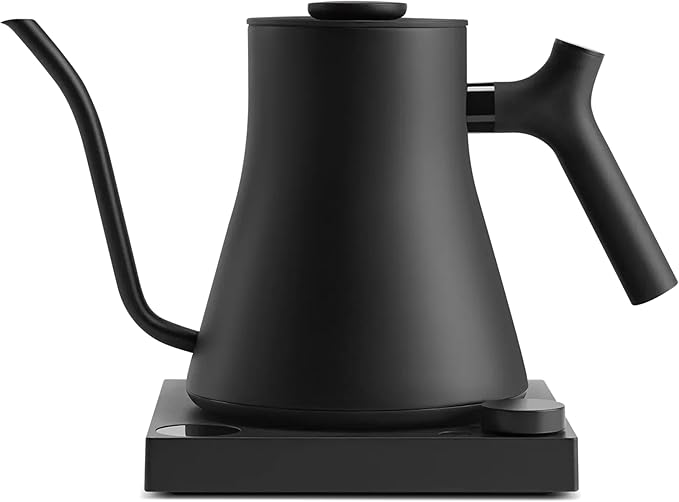
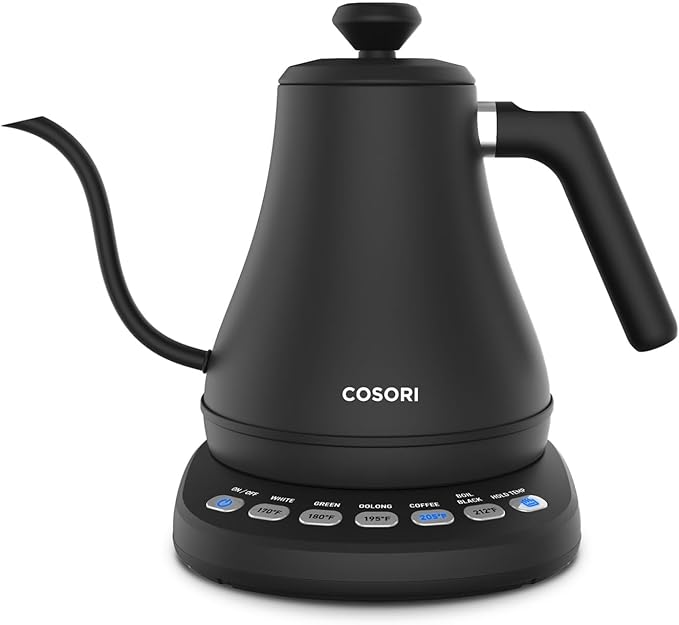
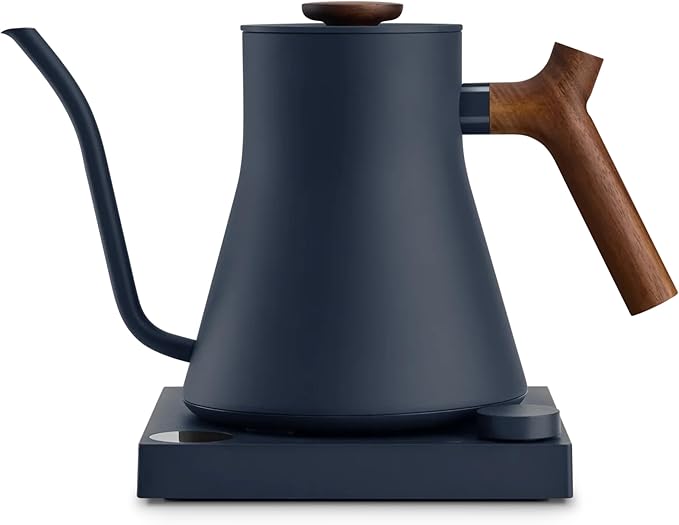
Fellow's Stagg EKG and the Cosori gooseneck sit at opposite poles of the same category. The Stagg is $180, comes from a specialty-coffee brand, and it's the kettle most third-wave cafes pull off the back bar for staff training. The Cosori is $70, comes from a kitchen-appliance brand with no coffee credentials, and it's the one sitting on most home brewers' counters. Both pour hot water. The question is whether what happens between the switch and the cup is worth $110.
We scoped this against daily pour-over use, not tea, not French press, not the occasional weekend brew. The two kettles separate on three things: how finely you can meter the pour during the bloom, how steady the temperature stays across a 3 to 4 minute brew, and how the kettle looks and holds up on a countertop you see every morning. Each section below takes one of those, and the verdict sits at the bottom.
How each one pours
This is the biggest functional gap between the two kettles. The Stagg EKG has a counterweighted handle and a spout geometry that lets your wrist meter the flow continuously, from a thin trickle up to a full stream. With a little practice, one kettle does a slow bloom pour and a fast fill-up without ever touching the switch. The Cosori has the same gooseneck shape, but the spout is wider at the base and the handle balance is different, so pour rate is effectively one speed: a controlled medium stream. Slow bloom pours mean tilting the kettle nearly horizontal, which sloshes water against the lid and changes the rate halfway through. On a recipe calling for a 30 second bloom at 60 grams of water, the Stagg hits the target and the Cosori overshoots.
Temperature precision
Fellow rates the Stagg EKG at ±1°F precision with PID temperature control on the product page, and it holds the set temperature across the entire pour window. Set it to 200°F and it stays between 199 and 201 from the first drop to the last. The Cosori uses preset buttons instead, 5 presets between 160 and 212°F, with no PID hold. It hits the target on the initial boil, then drifts down 4 to 6°F over a 3 minute brew window unless the hold function is on. On a light roast, where extraction is fussy about temperature, that drift is the difference between a clean cup and an underextracted one. On medium and dark roasts it vanishes into the margin of error.
How long the water stays hot
Both kettles hold, but they hold differently. The Stagg EKG holds its set temperature indefinitely, with no auto-shutoff while it sits on the base, and the LCD variant shows the water temperature live. The Cosori holds for 60 minutes per the product listing and then shuts itself off. For a single brew, fine. For a slow morning where the kettle sits between cups, the Stagg keeps water at temperature for hours and the Cosori needs a re-boil. Re-boiling concentrates dissolved solids slightly and changes the cup, which some drinkers care about and others never notice.
On the counter
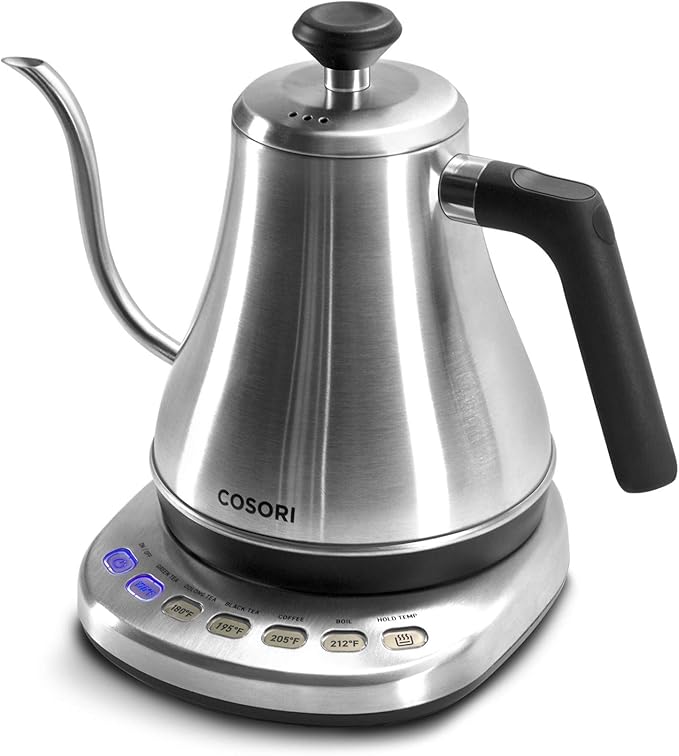
The Stagg EKG looks like a piece of furniture. Matte powder-coated exterior, walnut accent handle on the studio edition, a base that is a designed object in its own right. People leave it out where they can see it, and the marketing leans on that hard for a reason. The Cosori looks like a kitchen appliance: brushed stainless body, plastic base, a small LCD on the base for temperature. It's fine. It's not embarrassing. It also lives in a cabinet between uses for most owners. If counter space and visual identity matter to you, that's $110 well spent. If they don't, it's $110 gone. The water doesn't know which kettle it came from.
Durability over 3 to 5 years
Fellow sells replacement parts, base, lid and gasket, through its own site, and the Stagg EKG has been on the market since 2017 with the same core design. Owners on coffee forums report 4+ year units still running, and the usual failure is the base contact wearing out, a $40 replacement. The body is double-walled stainless inside the powder coat. Cosori sells no replacement parts for the kettle and the warranty is 2 years. Base electronics failing in year 3 come up often, so the kettle is effectively disposable past the warranty window. At $70, replacing it every 3 years works out to $23 per year, which lands in the same range as keeping a Stagg for 6+ years at $180. The math is closer than the shelf price makes it look.
Who should buy the Stagg EKG
Daily pour-over drinkers who follow a recipe with timed pours and weigh the water. The variable-speed spout and the PID hold are the two features that change the cup, and a Stagg owner extracts more consistently than a Cosori owner using the same beans and grinder. If the kettle sits out and you see it every morning, the design keeps paying rather than being a one-time bit of vanity. Same answer if someone in the house is drifting toward specialty-coffee gear, a better grinder, a scale, recipe apps. Buy the Stagg first instead of last. It's the cheapest of those upgrades and the one that compounds with all the others.
Who should stick with the Cosori
Weekend brewers, dark-roast drinkers, and anyone who eyeballs the water volume. The Cosori boils to a preset temperature and pours through a gooseneck spout, and for a drinker who doesn't chase the last 5 percent of extraction, that's the whole feature set. The $110 you keep is real money. Same goes if the kettle pulls double duty for tea, instant noodles, or French press. The Stagg is tuned hard for pour-over coffee specifically, and its precision does nothing for a 212°F boil.
Verdict
The Stagg EKG earns the $110 premium for one buyer: the daily pour-over drinker who weighs the coffee, owns a real grinder, and brews to a timed recipe. That person gets better cups for 6+ years out of an object that looks like $180 the whole time. Everyone else should buy the Cosori, which is genuinely good enough, and put the $110 into better beans.
Recommended
Products related to this guide.