The Best Spice Rack Organizers for Cabinets on Amazon (2026)
By Erin Mitchell · Updated June 2026
Independent editorial guide. We never accept payment for coverage, though we may earn a commission if you purchase through our links.
Quick Take
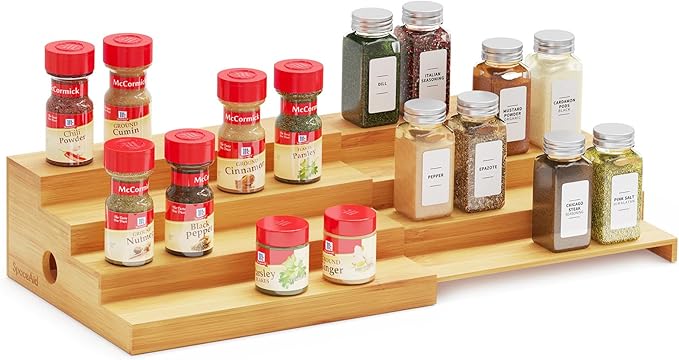
If your cabinet shelves are 10-12 inches deep and you want every jar visible without shuffling, a 4-tier stair-step riser is the most flexible answer. The SpaceAid 4-Tier Bamboo Spice Rack runs around $25, fits a standard 12 inch cabinet depth, holds 30+ standard jars across the steps, and lifts the back rows high enough to read labels from above. It solves the cabinet pain point, jars hiding behind jars, without making you commit to matching containers or a door-mount install.
Which pick is right depends on your setup: mismatched store-bought jars you plan to keep, a switch to a uniform 24 jar set, a deep pull-out to mount inside, or the cabinet door instead of shelf space. A tiered riser handles mixed-jar reality. A 24 jar labeled set replaces the chaos. A drawer-style pull-out works when shelves are too deep to reach the back. An over-the-door rack reclaims space when shelves are full. Below are the picks for each path.
Jump to our recommended risers, jar sets, pull-outs, and door-mount racks that fit a standard cabinet. See picks ↓
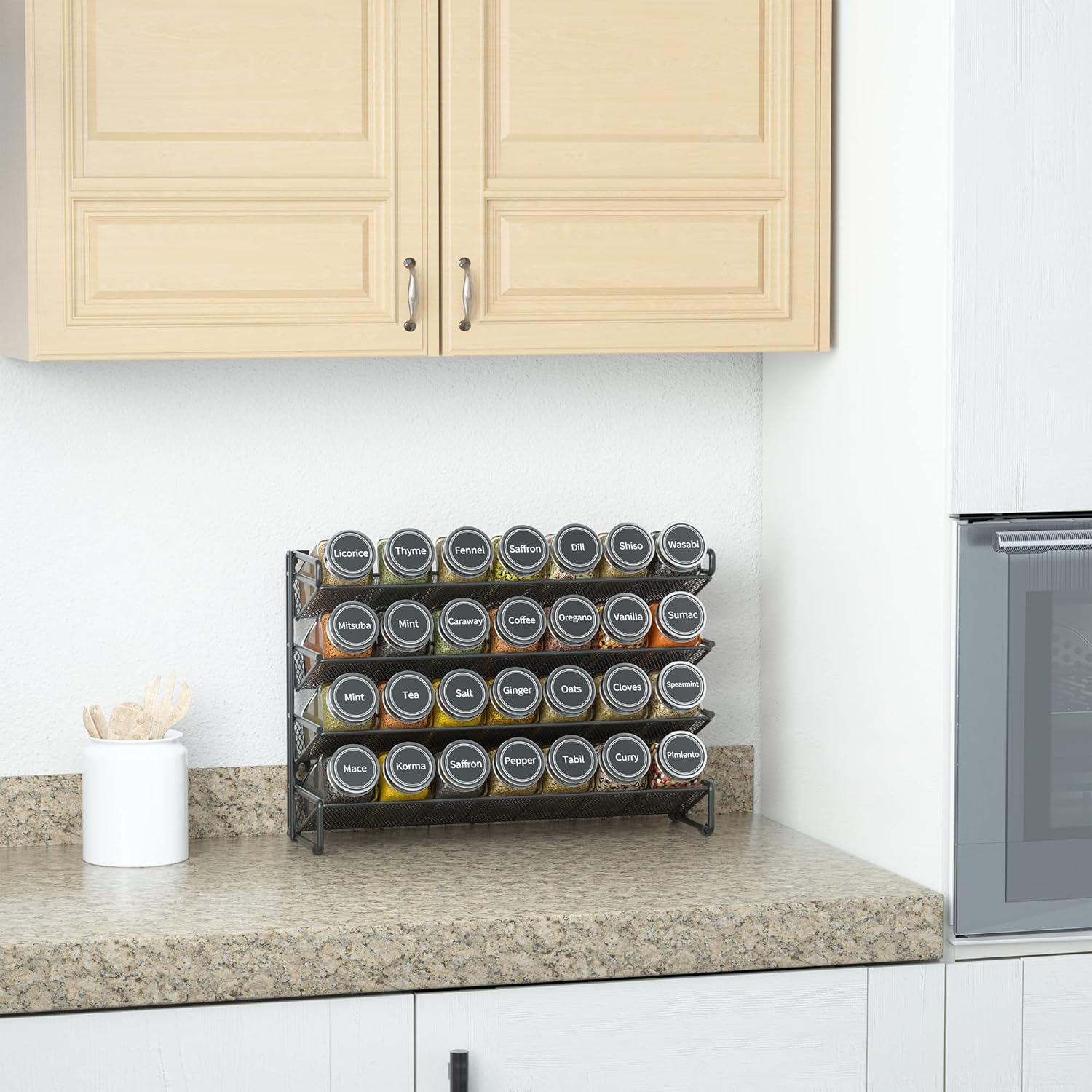
Spice cabinets fail in a predictable way: the jars in the back disappear, you buy a duplicate of the cumin you already own, and within six months the shelf is two-deep with bottles you can't read. The category that fixes this is broad (tiered risers, labeled jar sets, drawer pull-outs, door-mount racks), and the right answer depends on cabinet depth, your willingness to decant, and your budget. This guide picks across all four sub-categories so the recommendation matches your cabinet, not the other way around. Every pick is sized for a standard 12 inch cabinet shelf or a standard 24-30 inch cabinet door, with prices verified on Amazon at time of writing.
A cabinet rack solves a different problem than a countertop rack
Countertop racks optimize for display: rotating carousels, matching jars, decorative wood. Cabinet racks optimize for visibility under a fixed ceiling and within a fixed depth. You're looking down at the rack from above, or pulling it toward you, rather than at it from the side. That changes which forms work. A tiered riser dominates because it fixes the side-view problem from inside the cabinet, lifting the back rows so the labels angle up and read when the door swings open. A flat shelf or single-level organizer recreates the original problem at smaller scale.
Measure your cabinet before buying
Three numbers matter. Shelf depth: standard upper cabinets are 12 inches deep, but some are 10 or 14, and a 4-tier riser sized for 12 inches will hang off the front of a 10 inch shelf and waste space on a 14 inch one. Shelf height: tiered risers typically need 9-11 inches of vertical clearance, fine for a removable shelf, a problem if your cabinet has fixed dividers. Door clearance, for door-mount racks: measure the gap between the door's inner face and the front edge of the shelves with the door closed. If a basket would crash into a shelf, the over-the-door rack won't fit.
The four forms and when each one wins
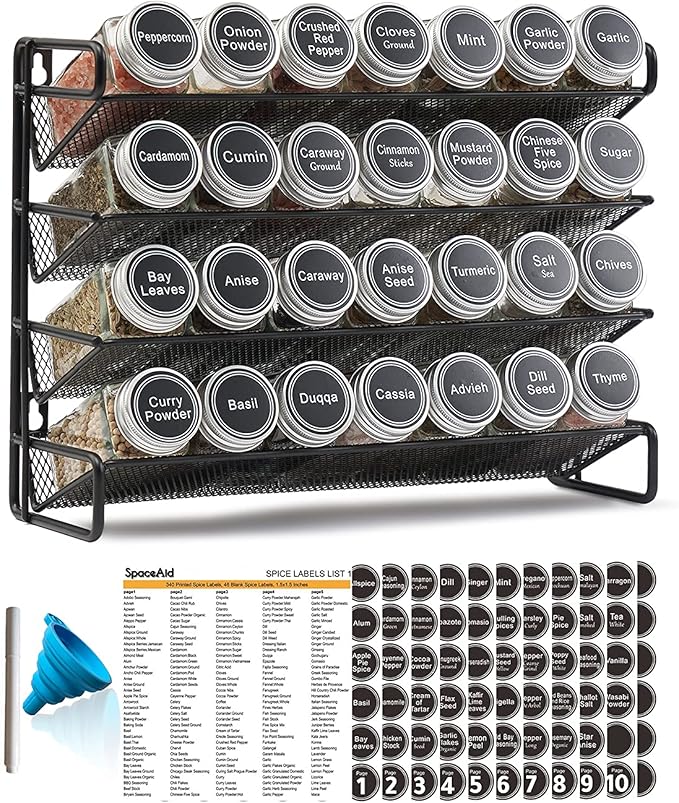
Tiered stair-step risers (the SpaceAid pattern) are the default. They fit any cabinet with 9+ inches of vertical clearance and 12 inches of depth, take mixed-size jars, and skip decanting entirely. The downside is that the bottom row still hides partly behind the front edge if you stuff it.
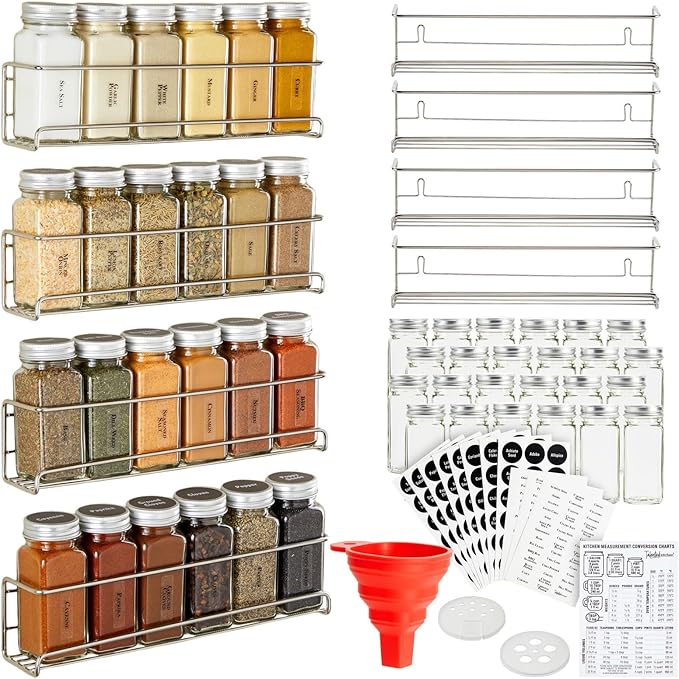
Labeled 24 jar sets (the Talented Kitchen pattern) kill the visibility problem outright, since every jar is the same size and the labels sit on top. You pay in the upfront labor of decanting and the ongoing discipline of refilling them when you buy a new bag of paprika instead of leaving it in the bag.
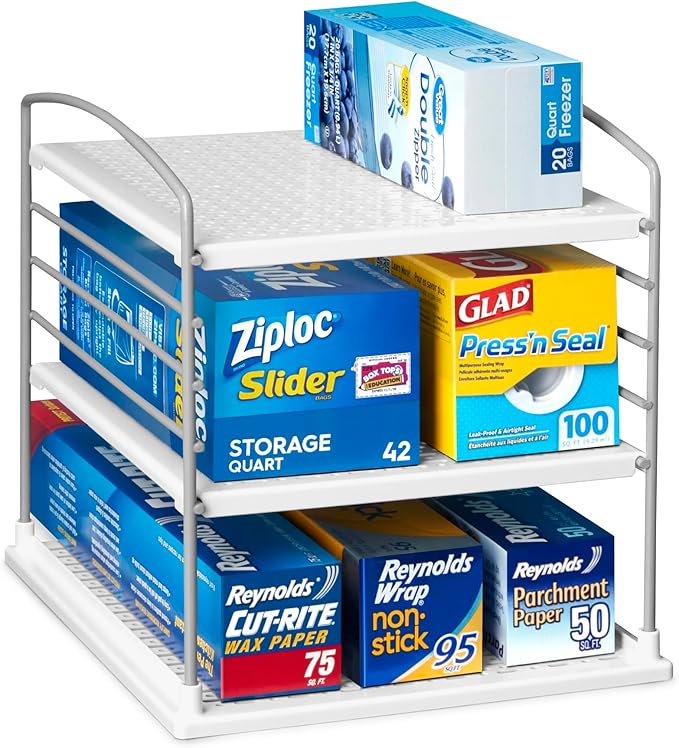
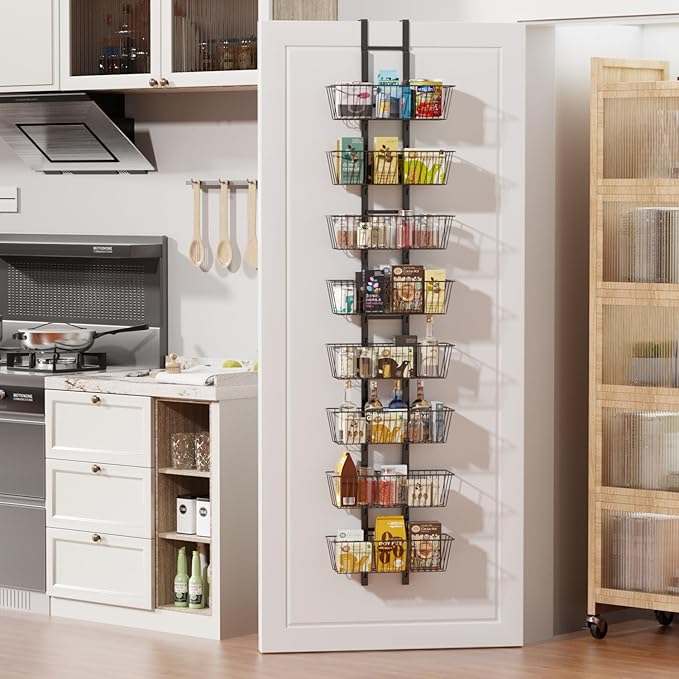
Drawer-style pull-outs (the YouCopia SpiceStack pattern) are the answer when the cabinet runs deeper than a tiered riser can reach (14+ inches), or when reaching to the back of an upper cabinet hurts. You pull the whole tier forward and pivot to read labels. Over-the-door racks are the recovery option when the shelves are already full of cookware and there's nowhere to put a riser. They reclaim the door's vertical space, but they need that door-clearance measurement and their weight limits rule out large jars.
Mixed jars versus decanting to a matched set
Decanting to a 24 jar set gives you the cleanest look and the best label visibility, and it costs you something. You're committing to refills instead of swapping in the next bottle of cumin. The shaker lids on most jar sets suit ground spices, not whole peppercorns or coarse sea salt. And if you cook from a deep collection (50+ spices), 24 jars won't cover it without overflow storage anyway. The tiered riser path makes more sense when your collection is genuinely mixed, some Costco-size bottles, some Penzeys bags, some Diaspora tins. The riser doesn't care about jar dimensions. You lose the matching-aesthetic win and gain practicality.
Bamboo, metal wire, and plastic
Bamboo risers (SpaceAid, Lavish Home variants) look better and wipe clean more easily when a jar leaks. They're heavier, which helps inside a cabinet since they don't slide, and mildly annoys during install. Metal wire racks are lighter and easier to see into, since you can spot jars through the rack, but they collect grime in the welds. Plastic drawer-style racks (YouCopia) are the lightest and easiest to pull, and they feel cheaper in hand.
What these cost
Tiered cabinet risers cluster at $20-35. Labeled 24-30 jar sets run $30-50. Drawer pull-outs are $20-45. Heritage countertop-style racks with included spices (Kamenstein) are $45-55. Over-the-door racks land at $30-45. None of these are expensive mistakes if you change your mind, which is why you should pick by form factor first and brand second.
Skip these
Skip rotating carousels meant for the countertop if you're storing in a cabinet. They waste the vertical space risers exploit. Skip lazy susan-style spinners in upper cabinets that aren't corner cabinets, since you'll be reaching past the spin axis to grab anything in the back. And skip any rack with a fixed footprint under 10 inches wide if you own more than 20 spices, because you'll outgrow it inside a year.
Recommended
Products related to this guide.
Frequently asked questions
What are the best spice rack organizers for cabinets?
SpaceAid 4-Tier Bamboo Spice Rack Organizer. The default cabinet answer.
What are the best budget spice rack organizers for cabinets?
SpaceAid Bamboo Spice Rack Organizer (Compact). Same bamboo build as the top pick at a lower price, with a smaller footprint for tighter cabinets or smaller spice collections.
What are the best premium spice rack organizers for cabinets?
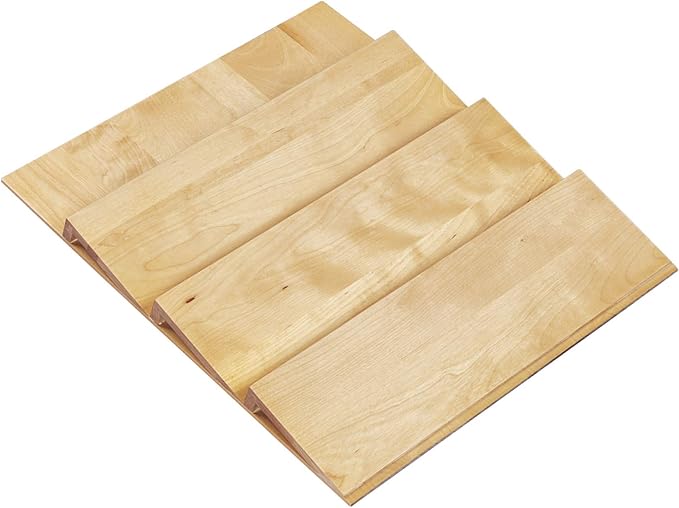
Rev-A-Shelf 4SR-18 Cabinet Pull-Out Spice Rack. Premium pull-out built like a cabinet accessory rather than a drop-in organizer.