Best Bedroom Ceiling Fans Without a Remote (Pull-Chain + Switch, 2026)
By Sam Hollis · Updated October 2026
Independent editorial guide. We never accept payment for coverage, though we may earn a commission if you purchase through our links.
Quick Take
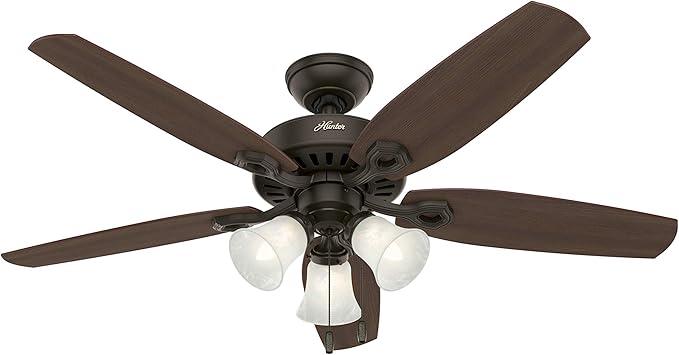
For a bedroom fan with no remote, buy the Hunter Builder Plus 52-inch. Pull chain for the fan, a separate pull for the light kit, and one of the quietest sub-$200 fans Hunter sells. If your ceiling is 8 feet, drop down to the Hunter Dempsey low-profile flush mount in the same family.
Losing the remote is a feature. Nothing to dig out from under the pillows, no CR2032s to buy twice a year, and your partner can hit the wall switch on the way to bed instead of hunting for a fob. What you give up is the sleep timer and dimming from the bed, and a smart bulb in the light kit covers the dimming half. Below are the pull-chain and wall-switch fans worth installing in a bedroom, from the quiet premium pick down to the budget pull-chain. See picks ↓
Most modern ceiling fans assume you want a remote. It ships in the box, the manual tells you to pair it, and plenty of newer DC-motor fans can't be run any other way without a hardware mod. Fine in a living room. In a bedroom it's a small daily irritation that compounds over years.
This guide is the opposite list. Every pick here works from a pull chain, a standard wall switch, or both. No app. No fob. No coin batteries. The shortlist leans on Hunter and Westinghouse, with Minka Aire at the premium end and Honeywell at the budget end. Sizing assumes a standard 10x12 to 14x16 bedroom with an 8 to 9 foot ceiling.
Pull chains still work
Remotes lose. Batteries die. Pairing breaks after a power cut. A pull chain is a piece of beaded metal screwed into a switch housing that has outlasted three presidents. If the fan still spins, the chain still works.
The tradeoffs are honest ones. No sleep timer. No dimming from bed unless you put a smart bulb in the light kit. And you have to get up and reach the chain at least once when you change speeds. For a bedroom that runs a single overnight speed most of the year, that's a fair price.
DC or AC motors
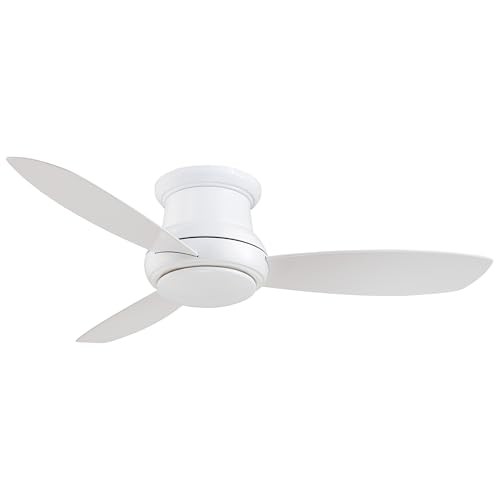
AC motors are the standard: cheap, durable, slightly louder. Most Hunter and Westinghouse fans under $200 are AC. DC motors are newer, draw less power, and run noticeably quieter at low speed, which is the speed a bedroom fan lives at. The catch is that most DC fans are remote-only, because the speed controller sits on the remote board. That is also why every fan on this list runs an AC motor, the Minka Aire Concept II included. It earned the quiet-pick slot on its flush-mount housing and Minka's WCS212 wall control, not on motor type.
Flush mount for 8-foot ceilings
Building code wants fan blades at least 7 feet off the floor. On an 8-foot ceiling a standard downrod fan eats most of the headroom above that, and tall people will feel it. A flush-mount or hugger fan pulls the motor housing tight to the ceiling and hands back 4 to 6 inches. The Hunter Dempsey low-profile is the workhorse, and the Minka Aire Concept II comes in a flush-mount variant too. At 9 feet or higher, skip this section and buy whichever fan you like the look of.
Blade span by room size
Quick sizing: 42 inches for a 100 sq ft bedroom, 52 inches for the 120 to 200 sq ft range that covers most US bedrooms, and 56 inches and up for a primary bedroom over 200 sq ft. Sizing up beats sizing down almost every time, because a bigger fan moves the same air at a lower, quieter speed.
Light kit or no light kit
If the fan is replacing the only overhead light in the room, you need the integrated light kit. Every pick here has one, on its own pull chain, so the light and the fan work independently. Put a smart bulb in the socket and you get dimming and scheduling without inviting a remote back into the room.
Installation, and when to call someone
If the room already has a fan-rated electrical box and a switched ceiling circuit, the swap is an hour's work for anyone comfortable with a screwdriver and a voltage tester. If what's up there is a lightweight pancake box rated for a light fixture only, stop and put a fan-rated brace box in first. A 20 pound fan on a 5 pound box is how ceilings end up on beds.
Recommended
Products related to this guide.
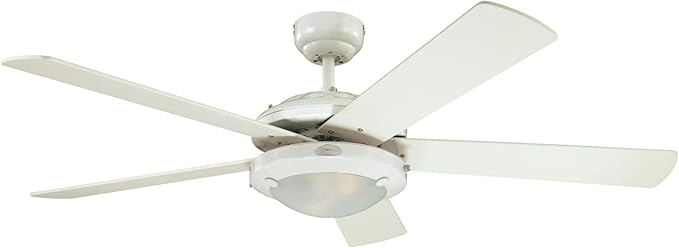
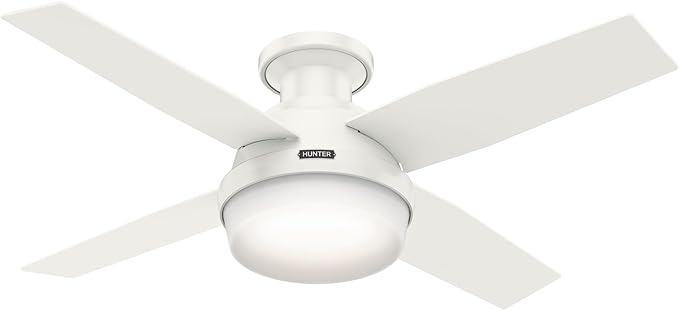
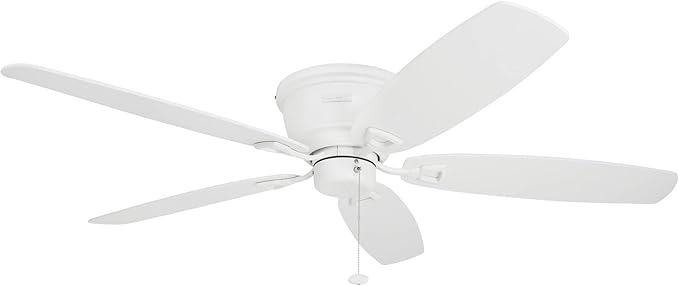
Frequently asked questions
What are the best bedroom ceiling fans without a remote?
Hunter Builder Plus 52-Inch Ceiling Fan with Light Kit and Pull Chain. The default answer for a bedroom under 200 sq ft.
What are the best budget bedroom ceiling fans without a remote?
Honeywell Quick 2 Hang 52-Inch Ceiling Fan with Light Kit. Cheapest pick that is not embarrassing.
What are the best premium bedroom ceiling fans without a remote?
Minka-Aire Concept II F519L-WH 52" LED Flush Mount Ceiling Fan. Hangs 11.